How to Find and Choose the Right Prompts to Track for AI Search Visibility
How to choose prompts for LLM tracking that mirror buyer intent. From persona simulations to multi-run validation, discover what prompts drive citations.

You already know the frustration: you open ChatGPT, ask for the best software in your niche, and watch the model recommend three of your competitors while completely ignoring your brand. You run the prompt a second time, and the answers change. You run it tomorrow, and the sources shift again.
If you treat AI prompt tracking like traditional keyword tracking, you will waste weeks collecting useless data. Large language models do not work with fixed monthly search volumes, and they do not return deterministic rank lists. They are probabilistic engines that synthesize answers from live grounding searches, semantic vector lookups, and internal reasoning.
To build an AI visibility strategy that actually moves business metrics, you need to uncover the exact conversational queries real buyers ask, test their statistical consistency, and identify which prompts trigger direct citations to your domain. Here is the exact five-step framework we use to find, validate, and monitor the right prompts for AI search visibility.
Why tracking prompts is not keyword research in disguise
Tracking prompts is fundamentally different from tracking keywords because conversational search queries trigger multi-step query decomposition and probabilistic synthesis rather than matching a single index. An AI engine breaks user prompts into sub-queries, executes real-time web searches, evaluates retrieved passages, and generates a fresh answer each time.
When someone types best rank tracker into Google, the search engine matches keywords against an inverted index. Every visitor in that location sees nearly identical results. But when a buyer asks ChatGPT or Perplexity for software recommendations, the engine interprets the buyer’s pain points, consults grounding sources, and constructs a custom comparison.
Three fundamental differences separate conversational prompt research from traditional SEO:
- Absence of static search volume: Traditional tools tell you that a keyword has 2,400 monthly searches. Prompts don’t have static search volume metrics because human conversations have infinite long-tail permutations. You track intent clusters and retrieval tasks, not verbatim word strings.
- Contextual customization and query fan-out: A prompt like “What alternatives do you suggest for SerpRobot for an agency managing 50 local clients?” forces the LLM to run multiple sub-queries behind the scenes (e.g., pricing comparisons, multi-location capabilities, client reporting).
- Probabilistic citation drift: In traditional search, a URL ranking in position 3 stays near position 3 until an algorithm update or competitor change occurs. In LLMs, a brand mentioned in run 1 might disappear in run 3 if the prompt isn’t statistically validated across repeated runs.
| Evaluation Metric | Traditional Keyword Tracking | LLM Prompt Tracking |
|---|---|---|
| Search Volume | Fixed monthly estimates (e.g., Ahrefs, GSC) | No static volume; conversational intent clusters |
| Output Format | Deterministic list of blue links (1 to 10) | Synthesized prose, comparison bullets, citations |
| Stability | Relatively stable daily positions | Probabilistic; answers and sources vary per run |
| Conversion Asset | Page 1 organic ranking | Clickable citation badge and direct pricing link |
| Search Execution | Single database query against an index | Multi-step query fan-out, retrieval, and grounding |
| Primary Goal | Maximize organic clicks | Win brand recommendations and domain citations |
Step 1: Build the project and buyer persona context baseline
Before asking an AI model to uncover prompt ideas, you must feed it an explicit baseline containing your target persona, core offerings, objections, and real customer language. If you query an LLM without giving it this context first, it will return generic listicle prompts that real buyers never type.
When consulting for SaaS founders and SEO clients, I always start by auditing CRM conversation logs, customer support tickets, and sales call transcripts. Your actual buyers rarely ask broad questions like “What is SEO software?”. They ask highly contextual questions reflecting immediate friction points:
- Primary industry and company size: A solo creator searches differently than a 20-person digital marketing agency.
- Core pain points and bottlenecks: Switching costs, expensive tier upgrades, missing local tracking features, or slow rank refresh cycles.
- Common sales objections: “Why should I pay for this tool if I already have Google Search Console?” or “Does this integrate with client reporting?”.
- Feature dealbreakers: Daily ranking updates, localized mobile tracking, or multi-engine AI monitoring.
Feed this operational baseline into your working prompt session before moving to persona simulations. When the model understands your operational boundaries, the queries it generates will mirror real purchase conversations.
Step 2: Reverse-engineer buyer intent with AI simulations
Reverse-engineering buyer intent requires prompting advanced reasoning models to adopt the specific role of your target buyer and simulate their exploratory and purchasing queries. Rather than guessing what prospects ask, you instruct the model to simulate their mental workflow from initial symptom recognition to vendor selection.
I use deep reasoning models (such as OpenAI o3, Claude 3.7 Sonnet, or Gemini 2.0 Pro) with a structured simulation prompt:
“Act as the head of SEO at a boutique agency with 30 clients. You are frustrated by unpredictable seat pricing and outdated rank trackers that don’t track AI search answers. List 15 specific, conversational questions you would ask ChatGPT or Perplexity to find, compare, and justify switching to a modern tracking tool.”
This simulation reveals prompts across three critical commercial stages:
Pain point and symptom prompts
Pain point prompts capture prospects when they experience an operational breakdown and ask an AI assistant to diagnose the cause.
These queries open with symptom modifiers:
- “Why doesn’t Google Search Console show the same keyword positions as third-party rank trackers?”
- “Why did my site traffic drop while my organic rankings stayed the same?”
- “How can I tell if ChatGPT is citing my competitors instead of my website?”
Winning citations on symptom queries allows you to establish technical authority before the buyer has even formed a vendor shortlist.
Commercial and comparative prompts
Commercial and comparative prompts occur when the prospect is actively evaluating solutions and asks the model to compare specific alternatives.
These queries represent your highest-converting opportunities:
- “What is the best SEO software for small agencies in 2026?”
- “What alternatives do you suggest for SerpRobot?”
- “Wincher vs ProRankTracker vs TrueRanker: which tracker offers the best local tracking?”
Let me share a real scenario from our own tracking dashboard that proves why comparative prompts matter far more than broad category queries.
Last week, when reviewing our global prompt tracking runs across the United States, United Kingdom, and India, I noticed a stark contrast between two types of prompts:
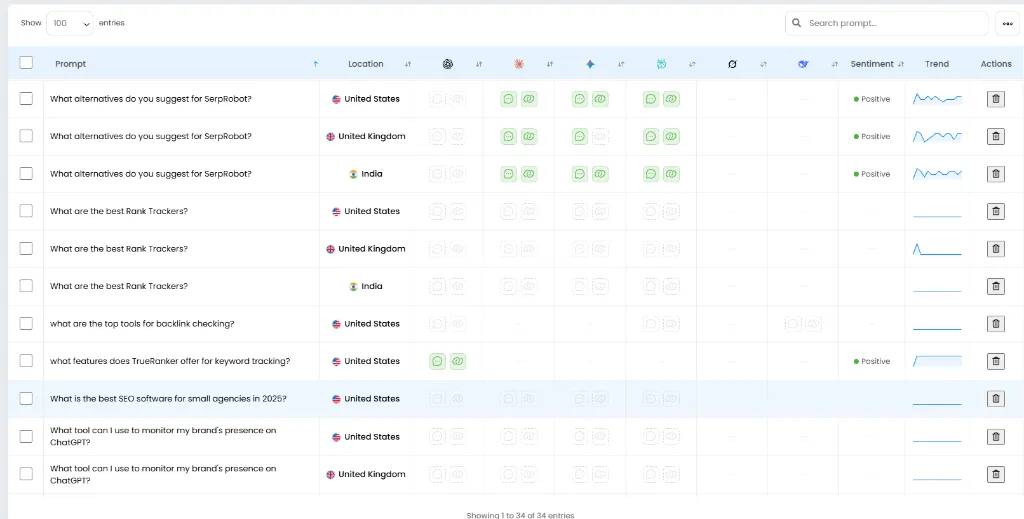
Looking at broad category prompts like “What are the best Rank Trackers?”, the visibility trend was largely flat across models. Why? Because broad queries trigger generic summaries derived from legacy affiliate listicles that have existed for a decade.
Now look at the competitor displacement prompt right at the top of that dashboard: “What alternatives do you suggest for SerpRobot?”. That prompt showed positive sentiment and active green citation indicators across Claude, Gemini, and Copilot.
When I opened the detailed ChatGPT inspection scan for that exact query in the United Kingdom, the result was eye-opening:
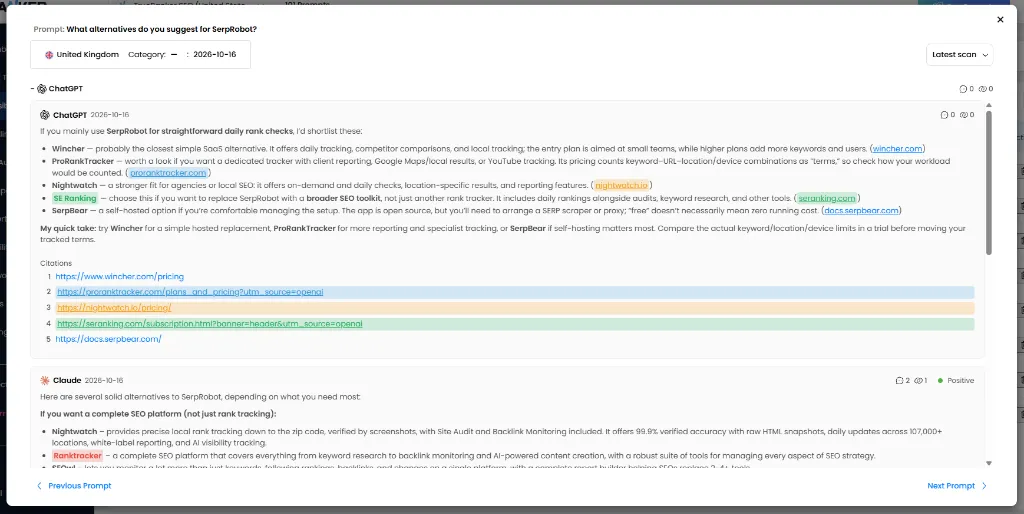
ChatGPT didn’t just mention names; its grounding search pulled citations directly from pricing pages. Look closely at the citation list at the bottom of the scan:
https://www.wincher.com/pricinghttps://proranktracker.com/plans_and_pricing?utm_source=openaihttps://nightwatch.io/pricing/https://seranking.com/subscription.html?banner=header&utm_source=openai
Notice that two of those citations carry explicit utm_source=openai parameters. That means OpenAI’s search engine actively crawled those pricing and comparison pages, verified their plans, and placed direct, clickable conversion links in front of a buyer looking to replace an existing tool.
If you only track generic terms, you will completely miss where real purchasing decisions happen in conversational search.
Proximity and transactional queries
Proximity and transactional queries capture local and immediate buying decisions where geographic location or immediate execution dictates the recommendation.
These queries use localized parameters:
- “What are top-rated technical SEO consultants near Manchester for Shopify stores?”
- “Where can I track daily Google Local Pack rankings for multiple locations?”
AI assistants consult both local web data and mapping knowledge bases to answer these queries. Tracking them requires segmenting your prompts by country and city to catch regional citation variations.
Step 3: Crawl grounding sources in connected AI search engines
Crawl grounding sources by testing your candidate prompts in web-connected AI engines to uncover which publisher domains and directories feed their citations. AI models do not generate brand recommendations out of thin air; they retrieve live information from a specific set of index sources before synthesizing their response.
When Perplexity, SearchGPT, or Gemini answer a prompt, they display footnote citations or clickable badges. Documenting these sources reveals the exact publication ecosystem that controls visibility for that prompt:
- Submit candidate prompts into connected engines: Run your initial list of 30 candidate prompts through Perplexity, ChatGPT Search, and Google AI Overviews.
- Catalog recurring citation domains: Note whether the engine cites independent reviews, Reddit discussion threads, official documentation, or industry roundups.
- Isolate domain patterns: If four out of five runs cite comparison articles from specific tech blogs or product landing pages, your website needs equivalent content depth or inclusion in those referenced publications.
- Discard disconnected prompts: If a prompt only triggers internal parametric training knowledge without performing web grounding searches, tracking citations for it will be unreliable. Focus on prompts that consistently trigger external web retrieval.
Understanding these retrieval mechanics is essential for AI search ranking factors, where grounding relevance directly dictates which domains earn citation badges.
Step 4: Validate prompts with statistical frequency testing
Statistical frequency testing validates whether a prompt produces consistent brand visibility by executing the query between 60 and 100 times to measure its true probability of citation. Because generative models are non-deterministic, testing a prompt once or twice provides zero statistical reliability.
In our testing, an unvalidated prompt can mention a brand on Tuesday morning and completely omit it on Wednesday afternoon. This variance happens because temperature settings, seed variations, and dynamic web index retrieval alter the model’s output on every execution.
Prompt Reliability Threshold:
  Single run test:     ~10% to 20% statistical confidence (Meaningless)
  10 runs test:        ~50% confidence (High variance)
  60 to 100 runs test: >95% confidence (Reliable commercial baseline)
During this testing, you must measure two distinct outcomes:
- Brand Mention Rate: The percentage of runs where the model names your company or product in the synthesized text.
- Domain Citation Rate: The percentage of runs where the engine includes a clickable link directly to your website in its grounding footnotes.
A brand mention builds passive awareness, but a domain citation drives referral traffic and qualified buyers directly into your funnel. If a prompt yields a 40% mention rate but a 0% citation rate after 80 runs, you know that the model recognizes your brand entity but cannot find a clean, extractable URL to cite as evidence.
Need to automate this testing? Manually running 100 queries across five different AI platforms consumes hours and burns API credits. You can track conversational visibility and citation rates automatically with our AI visibility tracker, giving you clear probabilistic trendlines without writing custom scraping scripts.
Step 5: Cluster by semantic facets and structure your content for AI chunking
Cluster your validated prompts into informational and transactional facets, then optimize your content structure with direct answer blocks so AI crawlers can effortlessly extract and cite your pages. Once you have a clean list of validated prompts, you must organize them into logical groups that guide your publishing roadmap.
We divide validated prompts into two primary operational facets:
- Informational facets: Questions regarding definitions, architectural comparisons, troubleshooting, and best practices. These belong in structured blog posts and documentation hubs.
- Transactional facets: Queries comparing pricing, tool migrations, feature parity, and commercial alternatives. These belong on dedicated product pages and comparison landings.
To make your content easily extractable by retrieval engines (chunking optimization), place a direct, self-contained answer of 1 to 2 sentences immediately beneath every H2 and H3 heading. Avoid introductory fluff or conversational throat-clearing. When an AI crawler segments your HTML document into semantic chunks, that opening answer provides the exact quote the LLM needs to cite your page.
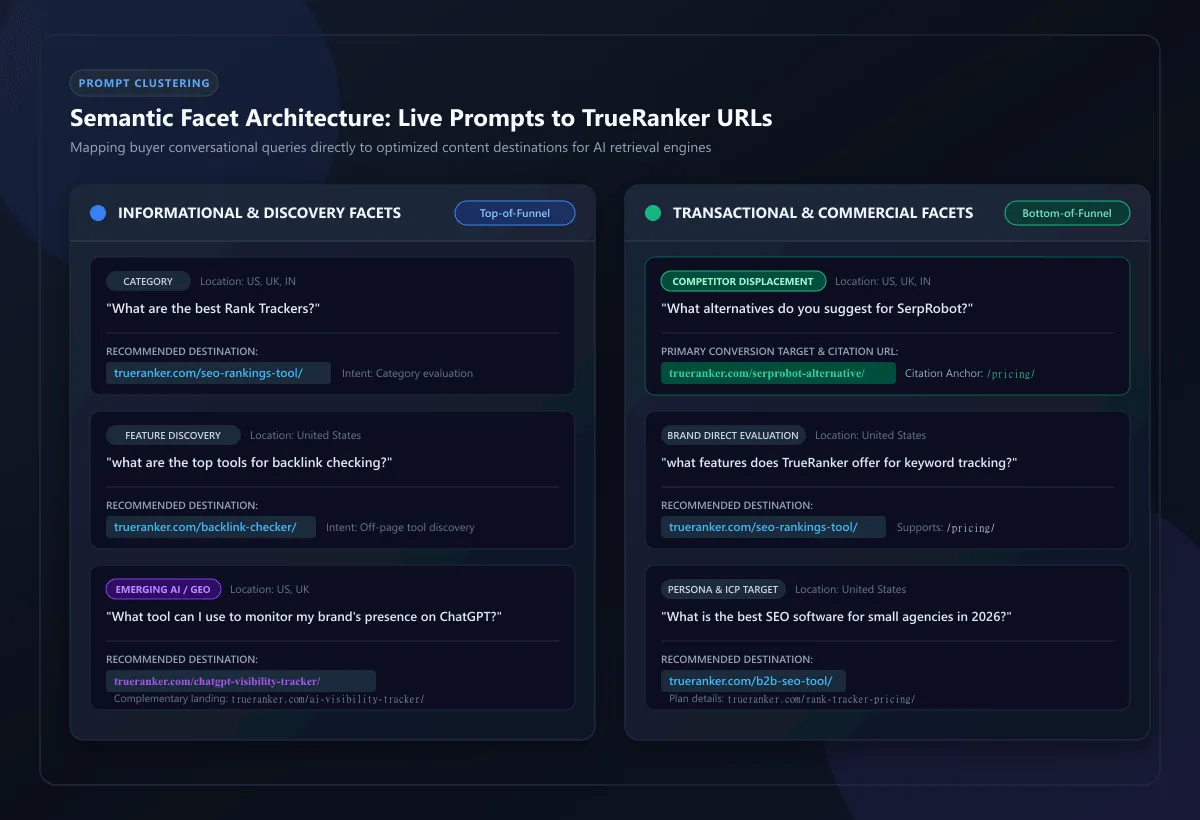
The table below illustrates how we map each validated prompt from our dashboard scan to its target operational facet, conversion intent, and corresponding TrueRanker landing page:
| Tracked Buyer Prompt | Semantic Facet | Conversion Intent | Target TrueRanker URL | AI Extraction Heading (Chunk) |
|---|---|---|---|---|
| “What alternatives do you suggest for SerpRobot?” | Transactional | Competitor displacement (Bottom-of-Funnel) | /serprobot-alternative/ & /pricing/ |
Why TrueRanker is the closest direct alternative to SerpRobot |
| “What are the best Rank Trackers?” | Informational / Category | Broad capability evaluation (Top-of-Funnel) | /seo-rankings-tool/ |
What makes a modern rank tracker in 2026? |
| “what are the top tools for backlink checking?” | Informational / Discovery | Secondary feature evaluation | /backlink-checker/ |
Real-time backlink auditing without enterprise pricing |
| “what features does TrueRanker offer for keyword tracking?” | Transactional | Brand direct & feature parity | /seo-rankings-tool/ |
Core keyword tracking capabilities in TrueRanker |
| “What is the best SEO software for small agencies in 2026?” | Transactional / ICP | Agency buyer persona (High-intent B2B) | /b2b-seo-tool/ |
Why boutique SEO agencies choose TrueRanker over per-seat platforms |
| “What tool can I use to monitor my brand’s presence on ChatGPT?” | Emerging AI / GEO | AI search monitoring & reputation | /chatgpt-visibility-tracker/ |
How to monitor brand mentions and citations on ChatGPT |
How to automate prompt discovery and tracking without manual scripts
Automating prompt tracking through dedicated software eliminates the engineering overhead of writing custom API scripts and managing headless browser scrapers. Tracking prompts by hand across ChatGPT, Claude, Gemini, and Perplexity is unsustainable for any growing business or agency.
Building an internal tracking workflow requires handling rotating proxies, parsing unstructured markdown outputs, dealing with rate limits, and paying per-token API bills that escalate rapidly when testing 100 runs per prompt. Furthermore, standard API endpoints do not always replicate the exact web-grounding behavior of consumer-facing interfaces like ChatGPT Search.
This is why we built the ChatGPT visibility tracker inside TrueRanker. Instead of wrestling with manual spreadsheets, the platform handles the entire workflow:
- Automatic prompt suggestions: Discovers conversational queries relevant to your industry based on real user search behavior.
- Multi-model continuous monitoring: Runs automated scans across ChatGPT, Claude, Gemini, Copilot, and Perplexity across multiple countries.
- Sentiment and citation breakdown: Tells you whether your brand sentiment is positive, neutral, or negative, and flags whether competitors are stealing your citations.
- Share of voice calculations: Quantifies what percentage of category prompts your brand controls compared to your primary rivals.
You can view our flexible monitoring limits and plans on our pricing page without getting locked into restrictive enterprise contracts.
Frequently asked questions
How many prompts should I track initially?
You should track an initial batch of 20 to 40 prompts divided evenly between commercial comparison queries and high-intent problem queries. Starting with a focused list prevents budget dilution and allows you to establish a clear baseline of citations before expanding into broader long-tail variants.
Can I track prompts if every user asks ChatGPT differently?
Yes, you can track prompts effectively because AI models map thousands of individual phrasing variations to the same underlying retrieval tasks and semantic concepts. You do not need to track every verbatim wording; monitoring the core conversational query captures how the model responds to that entire cluster of intent.
What is the difference between a brand mention and an AI citation?
A brand mention occurs when an AI engine writes the name of your product in its text response, whereas an AI citation includes an active, clickable hyperlink to your domain in the grounding sources. Citations drive high-intent referral traffic and prove that the model extracted factual information directly from your URL.
How often should I update the prompt tracking list?
You should audit and refresh your prompt tracking list every 30 to 60 days to remove queries that generate zero web-grounding activity and add new customer questions from your CRM. As LLMs evolve their search integrations and your competitors publish new content, customer phrasing will naturally shift.
Track what AI engines say about your brand
TrueRanker discovers real buyer prompts and monitors citations across ChatGPT, Perplexity, Claude, and Gemini automatically.
Written by

Javier Quevedo
Co-Founder & CEO, SEO Lead
Javier co-founded TrueRanker and leads the frontend, the public website, and the last mile between a ranking in the database and the screen an SEO actually uses. He has spent years turning GEO, local SEO, on-page work and AI visibility into product — and into the guides on this blog — so agencies can measure ChatGPT citations the same way they already measure Google. He also works the backend: a clean interface over stale data is still a lie.
You might be interested
What Is llms.txt? What the Data Says and Whether You Actually Need One
What is llms.txt, what does the data say about it, and do you actually need one? A practical guide for SEOs — no hype, just evidence.
Javier Quevedo12 min read
Read the postThe AI search optimization checklist I run before I change a page.
This AI search optimization checklist starts with one prompt. I show what to check, how to read a mention versus a citation, and when a change did nothing.
Javier Quevedo10 min read
Read the postAI search ranking factors only count when a citation moves.
AI search ranking factors are why one page gets cited in ChatGPT or Perplexity and another does not. Here is what I check on a single prompt.
Javier Quevedo12 min read
Read the postWhy your Google ranking says nothing about your AI visibility
Ranking #3 on Google does not put you in ChatGPT's answer. Here is why the two came apart, and what to measure instead.
TrueRanker2 min read
Read the postWhat Is AI Brand Monitoring? (And Why It’s Crucial in 2026)
Discover what AI Brand Monitoring is, how it differs from traditional SEO, and how to use TrueRanker to measure your Share of Voice and more.
Javier Quevedo6 min read
Read the postAI Share of Voice: How to Tell if ChatGPT Recommends Your Competitors [2026]
Losing an LLM recommendation means losing a sale. Learn to measure Share of Voice against your rivals and read what ChatGPT says about you.
Javier Quevedo4 min read
Read the post