AI search ranking factors only count when a citation moves.
AI search ranking factors are why one page gets cited in ChatGPT or Perplexity and another does not. Here is what I check on a single prompt.

The pattern is familiar. You sit on page one for a commercial query, you paste that query into ChatGPT, and a competitor owns the answer.
AI search ranking factors are the reasons that happens. They’re not a secret copy of Google’s ranking systems, and they’re not a score someone publishes with decimal weights.
They’re what has to be true before an assistant retrieves a page, trusts it enough to use it, and either names you or actually cites the URL.
That last split is the whole job. A mention without a URL is brand awareness. A citation is the click.
What AI search ranking factors are
AI search ranking factors are the reasons a generative engine puts your URL behind an answer, not the reasons you rank in the blue links.
Classic search returns a ranked list. You can be third and still be visible. An assistant writes one answer. Either your page is in the small set it used, or it isn’t, and there is no page two.
Here’s the pattern. An SEO ranks second for “best rank tracker for agencies.” They ask ChatGPT the same question. The model names a competitor and cites a roundup. The ranking didn’t fail. The citation job did.
That’s why I treat these factors as source-selection conditions, not as a ranking you can export from Search Console.
Google AI search ranking factors are not a published weight list
There’s no published weight list for Google AI search ranking factors in AI Overviews. Google publishes ranking systems that already sit under ordinary Search: BERT, RankBrain, passage ranking, MUM, freshness, link analysis.
Those systems explain how Google retrieves and ranks documents. They don’t tell you the percent chance your URL becomes a cited source inside an Overview.
If someone sells you “the official AI Overview factor list,” they invented it. What you can actually work from:
- The page has to be indexed and crawlable, or retrieval never sees it.
- The passage has to answer the query, or passage ranking has nothing useful to lift.
- The source has to read as worth citing, or the Overview will quote someone else even when you outrank them.
A thin commercial landing can win the blue links while the Overview cites a documentation page that never ranked in the top three. Position didn’t transfer.
Why a Google ranking says nothing about AI visibility is the longer version of that split. About 400 commercial queries on that post, and the correlation was too weak to plan a quarter on.
Seven AI search ranking factors, and what each one changes in the answer
Seven AI search ranking factors cover the work I can actually inspect on a prompt: match, citation vs mention, entity, structure, freshness, reachability, and third-party corroboration.
I don’t score them out of 100. I ask, for one prompt, which of these failed.
| Factor | What it changes in the answer | How you check it on one prompt |
|---|---|---|
| Query match | Whether retrieval even considers your URL | Does the first screen of your page answer the prompt as asked? |
| Citation, not only a mention | Whether the reader can click through | Brand name in the prose vs a URL under it |
| Entity consistency and depth | Whether the model treats you as the same thing across pages | Same name, same offering, enough coverage to look like a source |
| Structure an answer can lift | Whether a passage is extractable | Direct answer, then a list or table, then the caveat |
| Freshness on dated queries | Whether last year’s page still gets used | Does the prompt imply a year, a price, or a current shortlist? |
| Reachability | Whether the page can enter the set at all | Indexed, not blocked, not a soft 404 |
| Third-party corroboration | Whether the model found you in sources it already trusts | Are you on the roundups and docs it actually retrieves? |
A 2023 paper on generative engine optimization tested writing tactics — quotations, statistics, citations on the page — and showed they can change how often a generative engine picks a source. I treat that as a writing tactic you can try, not as a ranked list you can prove from one prompt.
Query match: the page has to answer in the first lines
Query match means the page states the answer the prompt is asking for, in language close to how the person asked it, before the pitch.
If the prompt is “best rank tracker for a five-person agency,” and your H1 is a brand slogan, retrieval can skip you. Assistants lift passages, not slogans.
I open the URL, read the first 100 words, and ask: would I paste this paragraph into the answer? If I wouldn’t, the model probably won’t either.
A citation is not the same as a brand mention
A citation is a clickable source. A mention is the model saying your name in the sentence.
ChatGPT can name you and still send the click to a G2 article. Perplexity can cite you and barely say the brand. Those are different outcomes, and blending them into one “AI visibility” number hides the failure.
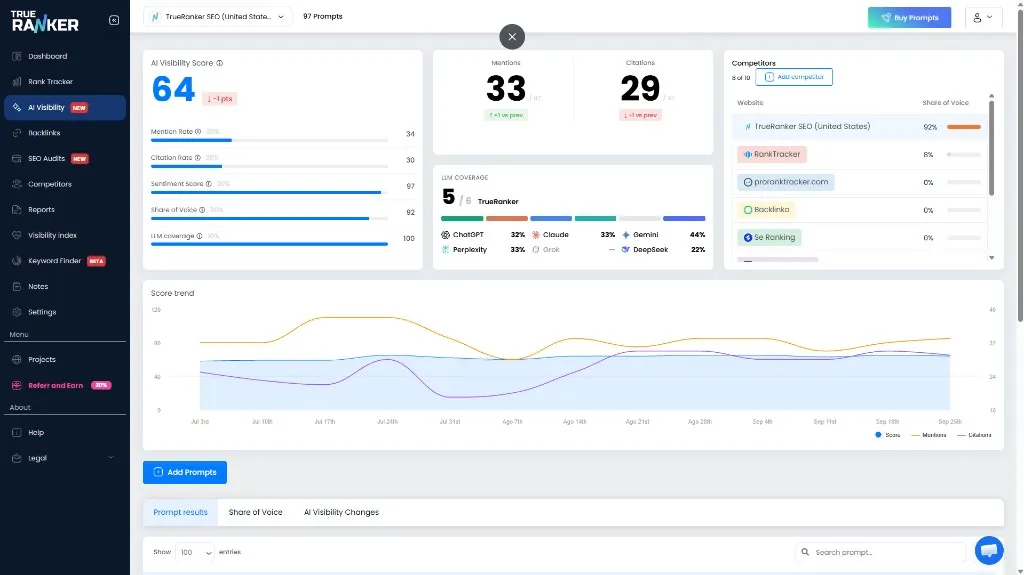
Mentions and citations are two counts. A single visibility score hides which one moved.
The longer split is in AI mentions vs citations. On a prompt, I only mark the factor as passing when the URL is in the source list, not when the prose is flattering.
Entity consistency and topical depth
Entity consistency means the model can tell you are the same company, with the same product, across the pages it retrieves. Topical depth means you have enough coverage to look like a source, not a one-page brochure.
If the homepage says “AI visibility platform,” the docs say “rank tracker,” and the blog says “GEO tool,” you’ve given the model three entities. It will pick the one it already has a clean record for — often a competitor.
I look for one name, one job, and a cluster of pages that actually answer adjacent questions. A one-page brochure doesn’t survive a prompt that asks for a comparison.
Structure an answer can lift
Structure an answer can lift: a direct opening sentence, then a list or a table, then the caveat. Models quote blocks they can lift without rewriting your whole landing.
A 2,000-word essay with the answer in paragraph nine loses to a 700-word page that puts the answer first. Length isn’t the factor. Extractability is.
When you rewrite a page for this, put the claim in the first two sentences of the section the prompt would land on, then the bullets. The metaphor goes last, or it goes away.
Freshness when the query is dated
Freshness matters when the prompt implies a current shortlist, a year, a price, or a “right now.” It barely matters on a definition that hasn’t moved.
“Best CRM for dentists 2026” is a dated query. “What is a citation in ChatGPT” isn’t. Updating the first one and ignoring the second is the right split.
I check the updated line the reader can see, and I check whether the facts on the page still match what the engines are saying this month. A stale comparison table is a gift to whoever published last week.
The page has to be reachable
Reachability means the URL is indexed, crawlable, and not a soft 404. If retrieval never sees the document, none of the other factors get a vote.
People polish FAQ schema on a URL that site: doesn’t return. The model can’t cite a page Google never fetched.
Noindex, a robots block, a canonical that points somewhere else, a login wall: any one of those ends the job before “ranking factors” start.
Third-party corroboration
Third-party corroboration is whether the model already found you on pages it trusts: docs, comparison articles, reputable lists. For “best X” prompts, it often reads those first and never opens your landing.
You can rank #1 and still lose the answer if you are absent from the three listicles the model likes. That’s aggregator mediation, and it’s why link-building for AI search is often getting named in the sources models retrieve, not collecting another homepage link.
I don’t treat that as “backlinks still matter, same as 2014.” I treat it as: which URLs does this prompt actually cite, and am I on them?
AI search engine ranking factors are not one list
AI search engine ranking factors aren’t one list. ChatGPT, Perplexity, Gemini and Google AI Overviews retrieve differently, cite at different rates, and will disagree on the same prompt.
I don’t invent a weight table. I look at what you can observe without pretending the labs published one:
- Perplexity is citation-heavy. If you never appear as a source there, “mention rate” on ChatGPT is the wrong comfort metric.
- ChatGPT will name brands in the prose and cite something else. That’s the mention-vs-citation trap.
- Gemini and Google AI Overviews sit closer to Google’s index. Being unindexed hurts you here first.
- The same prompt, same week, can cite you in one engine and skip you in another. That isn’t noise you ignore. It’s the reason you don’t optimize for a blended score.
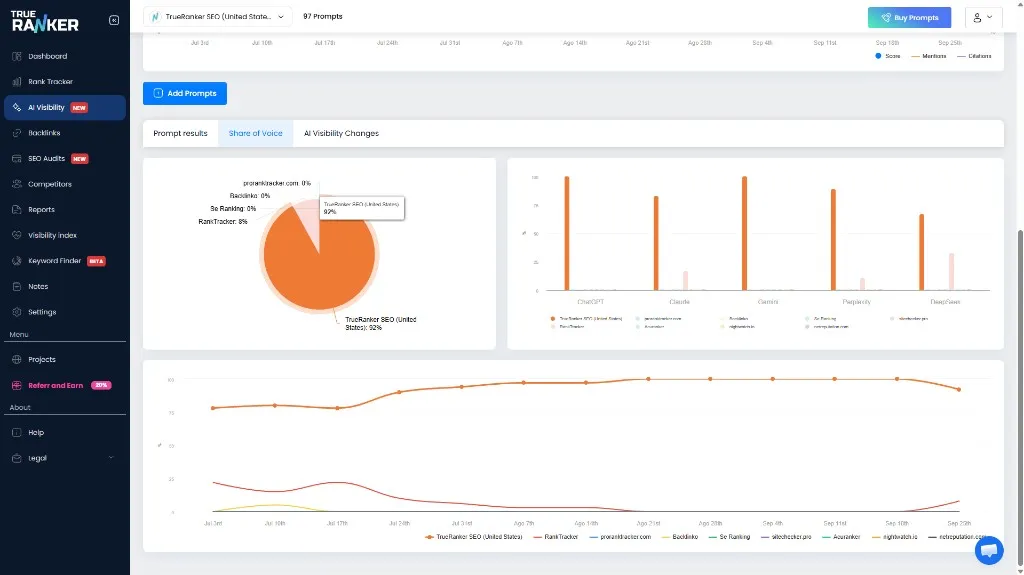
Share of voice isn’t the same in every engine.
If you only test ChatGPT, you are guessing the rest.
The best AI search ranking factors to fix first
The best AI search ranking factors to fix first are the ones that keep you out of the retrieved set, then the ones that turn a mention into a citation. I wouldn’t start with schema.
Order I’d use on a page this week:
- Can the URL be retrieved? Indexed, 200, not canonicalized away.
- Does the first screen answer the prompt? Query match before brand copy.
- Is the failure a mention or a missing URL? Don’t rewrite the whole site for a naming problem.
- Can a passage be lifted? Answer, list, caveat.
- Is the prompt dated? Refresh the shortlist if it is; leave the glossary if it isn’t.
- Is the entity messy? Align the name and the job across the cluster.
- Which third-party pages does this prompt already cite? Get into those, or write the page the model would rather cite than a roundup.
Schema markup is a nice extra for machines that parse it. It doesn’t, on its own, flip a prompt from “names a competitor” to “cites our URL.”
What changed in AI search ranking factors in 2026
What changed in AI search ranking factors in 2026 is the assumption that a top-10 Google ranking still predicts an AI citation. It predicts less than it did, and it was never a guarantee.
I still want the page to rank. Crawlability, a real answer, and a site people already cite are the floor. The mistake is treating position three as the same job as “ChatGPT used this URL.”
The rankings-versus-AI-visibility post is the evidence I’ll stand on: about 400 commercial queries, and Google position was a weak planner for whether the model named the brand. I’m not going to paste someone else’s 2026 percentage from a roundup I can’t cite.
The practical change is the unit of work. You don’t export keywords into an AI dashboard and call it GEO. You track the same business prompts and watch whether the cited URL is yours.
How to tell which factor moved on one prompt
You tell which factor moved by freezing one prompt, running it in more than one engine, and scoring mention and cited URL separately. A sitewide “AI score” can’t tell you that.
This is the check the checklists skip. They grade your domain. I grade one question.
Here’s the method. Pick a prompt a customer would actually type — “best rank tracker for agencies,” not your brand name. Run it in ChatGPT, Perplexity, Gemini, and Google’s AI Overview if it fires.
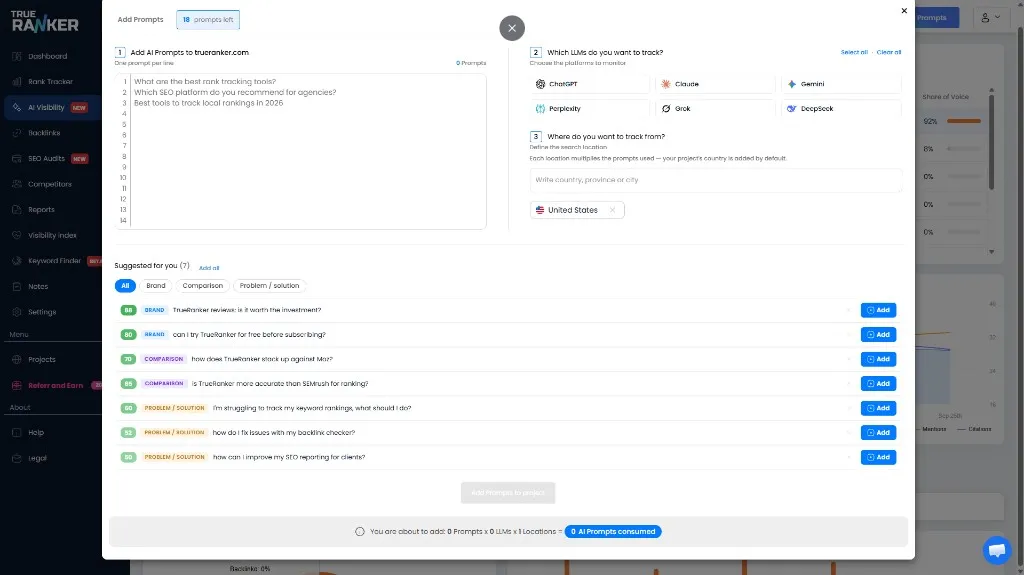
Same prompt, the engines you actually care about, one location.
For each engine, write two marks:
- Mention: does the prose name you?
- Citation: is your URL in the sources?
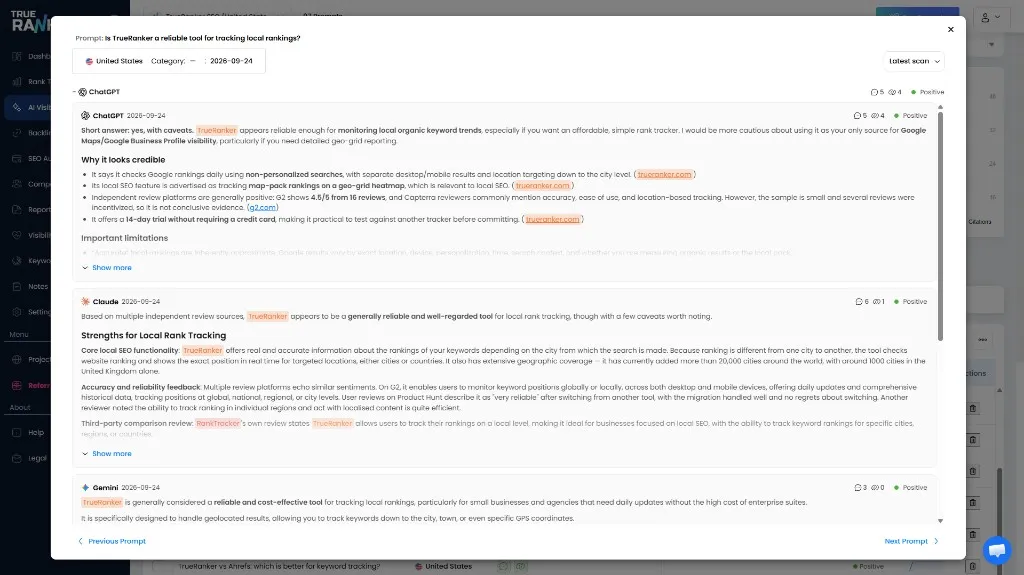
Open the stored answer. Highlight the brand name, then look for your URL.
Then map the miss to a factor:
- No mention, no citation, and
site:doesn’t return the URL → reachability. - No mention, the page exists, the first screen doesn’t answer the prompt → query match.
- Named in the sentence, roundup in the sources → citation vs mention, often plus third-party corroboration.
- Cited last month, gone this month, prompt includes a year → freshness.
- Cited in Perplexity, invisible in ChatGPT → engine difference, not a failed Core Web Vital.
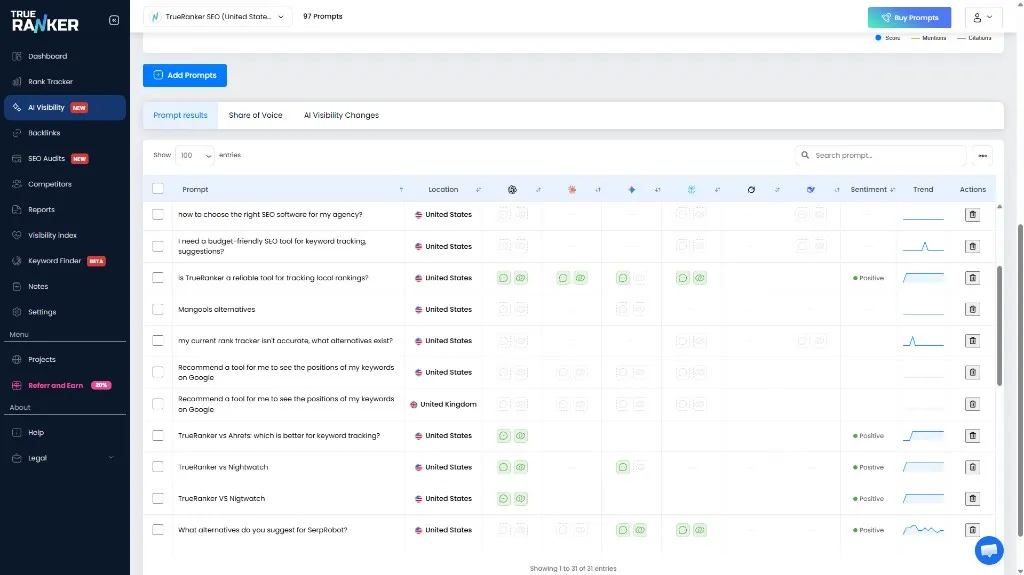
Mention versus citation, engine by engine, on the same tracked prompts.
If you want that check on a schedule instead of a tab you forget to reopen, track that prompt in ChatGPT. Mentions and citations sit in separate columns. The six-engine view lives on the AI visibility tracker.
Frequently asked questions
What are AI search ranking factors?
AI search ranking factors are what has to be true before ChatGPT, Perplexity, Gemini or a Google AI Overview uses your page as a source. They’re not Google’s published ranking systems copied into a new table.
Do you need to rank number one on Google to get cited?
No. Overviews and chat answers pull pages that aren’t in the top three all the time. You do need the page to be retrievable. Ranking helps. It doesn’t guarantee a citation.
Do AI search ranking factors change by engine?
Yes. Perplexity cites more. ChatGPT will mention you and cite someone else. Gemini and AI Overviews sit closer to Google’s index. Run the same prompt in more than one engine before you decide what to fix.
Does schema markup decide whether you get cited?
Schema can make a page easier to parse. It doesn’t, on its own, decide a citation. Direct answers, a reachable URL, and presence in the sources the model already reads do more.
How can I tell which factor actually moved?
Re-run one prompt and score mention versus cited URL, engine by engine, after the change. If the mention appears and the URL still doesn’t, you didn’t fix the citation factor. A blended visibility score will hide that.
See which engines cite you, and which only name you.
Track the same prompt in ChatGPT and the other engines. Mentions and citations sit in separate columns, so you can see which factor actually moved.
Written by

Javier Quevedo
Co-Founder & CEO, SEO Lead
Javier co-founded TrueRanker and leads the frontend, the public website, and the last mile between a ranking in the database and the screen an SEO actually uses. He has spent years turning GEO, local SEO, on-page work and AI visibility into product — and into the guides on this blog — so agencies can measure ChatGPT citations the same way they already measure Google. He also works the backend: a clean interface over stale data is still a lie.
You might be interested
The AI search optimization checklist I run before I change a page.
This AI search optimization checklist starts with one prompt. I show what to check, how to read a mention versus a citation, and when a change did nothing.
Javier Quevedo10 min read
Read the postWhy your Google ranking says nothing about your AI visibility
Ranking #3 on Google does not put you in ChatGPT's answer. Here is why the two came apart, and what to measure instead.
TrueRanker2 min read
Read the postWhat Is AI Brand Monitoring? (And Why It’s Crucial in 2026)
Discover what AI Brand Monitoring is, how it differs from traditional SEO, and how to use TrueRanker to measure your Share of Voice and more.
Javier Quevedo6 min read
Read the postAI Share of Voice: How to Tell if ChatGPT Recommends Your Competitors [2026]
Losing an LLM recommendation means losing a sale. Learn to measure Share of Voice against your rivals and read what ChatGPT says about you.
Javier Quevedo4 min read
Read the postAI Mentions vs Citations: The Key GEO Metric [2026]
Appearing in an AI response is not a binary goal. Learn the difference between a Brand Mention and a Citation, and why you need to measure both.
Javier Quevedo5 min read
Read the postGEO Guide 2026: 9 Steps to Optimize Your Website for ChatGPT & LLMs
Discover the 9 key tactics to get ChatGPT, Gemini, and Perplexity to recommend your brand. Shift from traditional SEO to GEO and dominate AI search.
Javier Quevedo6 min read
Read the post