The AI search optimization checklist I run before I change a page.
This AI search optimization checklist starts with one prompt. I show what to check, how to read a mention versus a citation, and when a change did nothing.

Here’s the pattern. An SEO ranks third for “best rank tracker for agencies.” They paste that question into ChatGPT. The model names a competitor and cites a roundup.
The ranking didn’t fail. The citation did.
An AI search optimization checklist is what I run first, so I don’t start rewriting that landing before I know which prompt I want to move, and whether the answer already names us or already cites someone else.
This AI search optimization checklist is what I run first, not an SEO audit
This checklist is what I use before I edit a page. It isn’t a technical SEO audit, and it isn’t a promise that ChatGPT will recommend you.
A site audit tells you whether the URL is crawlable, whether titles are unique, whether schema validates. Useful work. It doesn’t tell you what ChatGPT did with one buyer question.
Readiness on this checklist is a pass or a miss on that prompt. It isn’t a score for the domain.
I write the prompt first. I read the answer second. I change a page only if that answer shows a gap I can name. Then I ask the same question again.
If you skip the reread, you have a to-do list. You don’t have a result.
The eight checks I run, in this order
I mark a check only when I can see the result in the answer, not when a ticket on the site is done.
The gap most lists leave open is that last column. Schema can validate and the cited URL can stay the same.
| Check | What I look at in the answer | What a pass looks like |
|---|---|---|
| The buyer prompt | The exact question a customer would type | One commercial sentence, not a keyword |
| Mention, citation, or nothing | Whether the prose names us, and whether a URL sits under it | I can mark one of the three without guessing |
| Whose URL is cited | The host in the sources | I can name the domain |
| A sentence the model can lift | The first screen of the page I want cited | I would paste that paragraph into the answer |
| The same brand name in sources it already used | How those cited pages name us | Name and offering match ours |
| One change | What I actually edited | I can say it in one sentence |
| The same prompt again | The same wording, the same engines | I didn’t “improve” the question |
| The sentence I can report | Whether the mention or the cited URL moved | I can say which of the two changed, or that neither did |
If a row has no mark in the answer column, I don’t tick it. That’s the whole list.
Name the prompt a buyer would type
The first check is a prompt a buyer would type, written the way they would ask it, not the keyword you already rank for.
“Best rank tracker for a five-person agency” is a prompt. “Rank tracker” is a keyword. ChatGPT answers the first as a shortlist. It answers the second as a category.
The same person can have a rank tracker full of branded terms, run “rank tracker software” in ChatGPT, and get enterprise suites they don’t sell. The buyer never types that. They type the agency-size question.
I keep the string in a cell I can paste again next week. If I can’t paste it, I didn’t name it.
How I track that prompt in ChatGPT is the longer setup. I only need that sentence before I open the answer.
Keep the prompt list short
A short list of buyer prompts you can rerun beats a dump from the rank tracker.
I pick the questions that sit in front of a sale: compare, recommend, “best for.” I leave branded vanity queries for later. Visibility on your own name in ChatGPT is easy to collect and rarely the gap.
Five prompts you reread every week beat fifty you opened once.
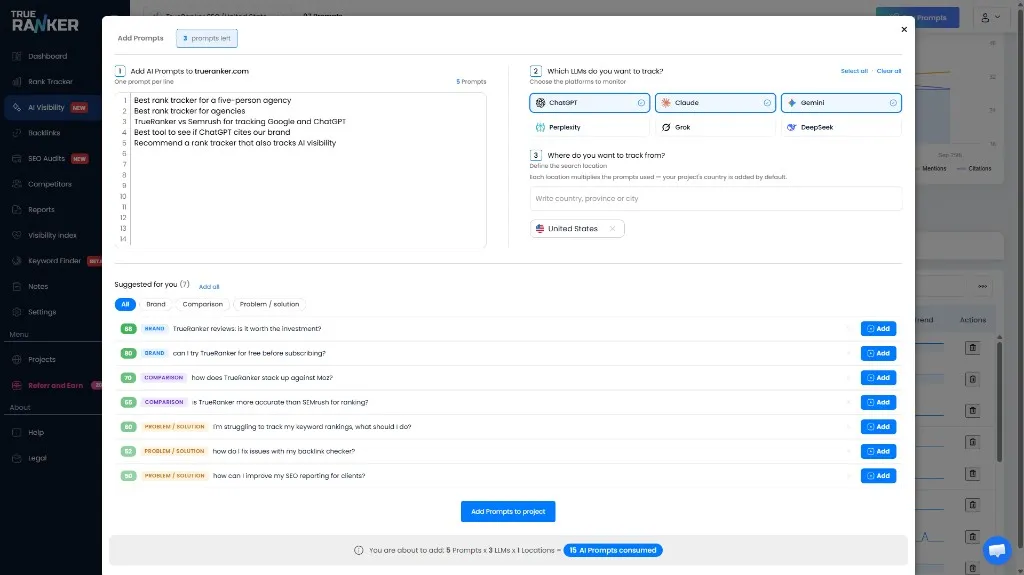
Five buyer prompts, the engines you actually care about, one location.
Read the answer before you edit the page
Before I edit the page, I write down whether the answer mentioned us, cited our URL, or did neither.
I don’t open Search Console first. I don’t add FAQ schema first. I open the answer.
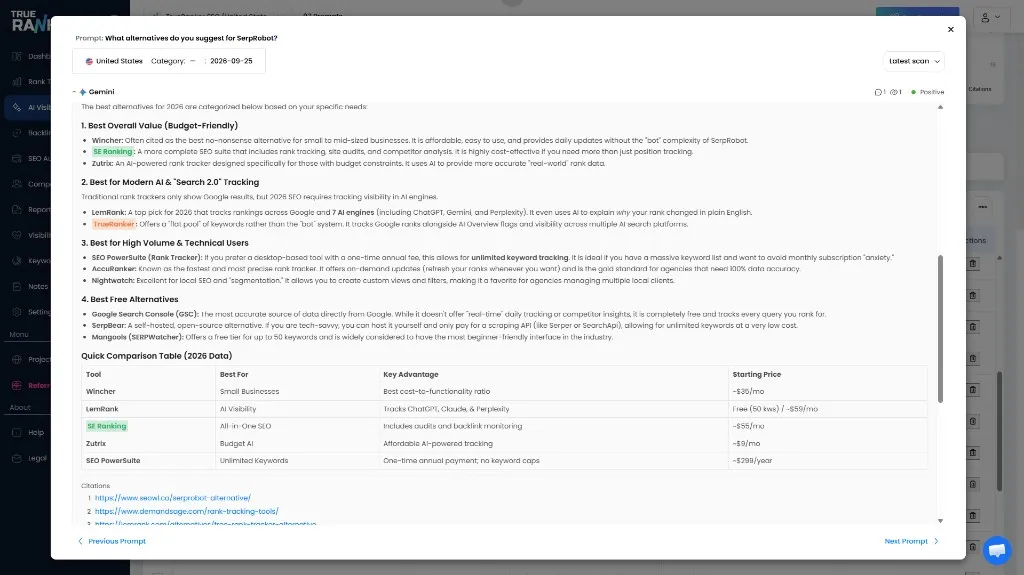
Open the stored answer. Mark the brand name, then look for your URL in the sources.
You can spend a morning on structured data and still watch ChatGPT name you and cite the same review site. The mention was already there. The cited URL never moved.
A blended AI visibility score can hide that split. I want two marks.
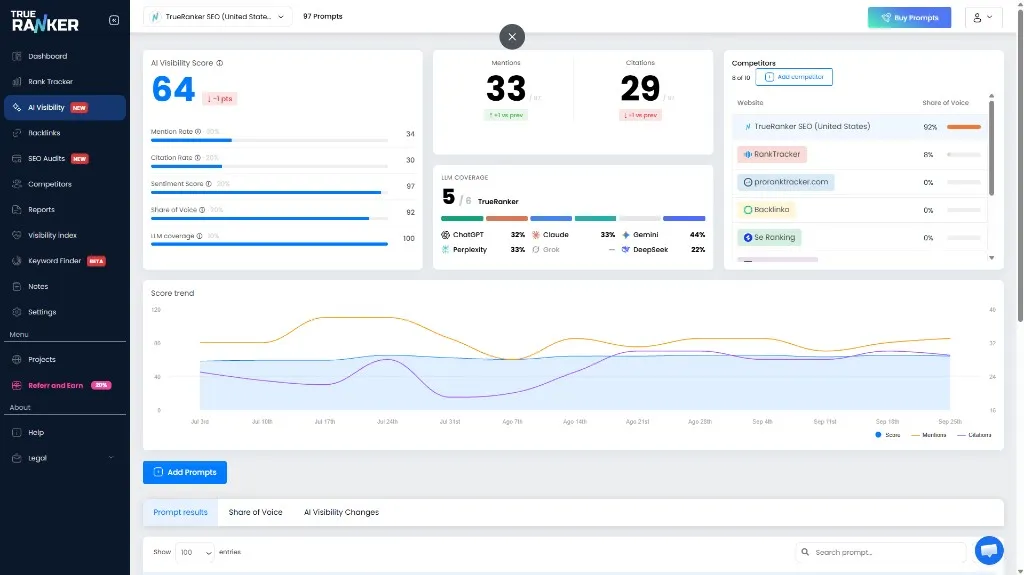
Mentions and citations are two counts. A single visibility score hides which one moved.
A mention isn’t a citation
A mention is your name in the prose. A citation is a URL the reader can open. The name without the URL isn’t the click.
I treat that split as the job. Mentions versus citations in ChatGPT is the longer version. I only need the two boxes.
If the model says “tools like yours” and never writes the brand, that’s nothing. If it writes the brand and cites a roundup, that’s a mention. Only our URL in the sources counts as a citation.
The cited URL is the only click
The cited URL is the only click the answer can send. If they name you and cite a listicle, the Google ranking didn’t fail. The citation did.
I write the host down. “g2.com” and “our pricing page” are different jobs. One means I have work off-site. The other means I have a page that almost made it.
Google AI Overviews do the same split when they fire: a sentence in the Overview, and a source you can click. I score those the same way I score ChatGPT.
Change the page only when this prompt needs it
I change the page only when this prompt shows a gap I can name. I don’t start with schema because a checklist said “machine-readable.”
If the first screen of our page doesn’t answer the question, I rewrite that paragraph. If the page already answers it and the model still cites a third party, the next check is the source list, not another H2.
Making the page machine-readable helps when a fact is already there and the HTML hides it. It doesn’t invent an answer the page never stated.
What I check when a citation doesn’t move is the factor list behind this step. I don’t rerun that whole list on every prompt. I pick the one miss I just wrote down.
A sentence the model can lift
The page I want cited has to open with a sentence I would paste into the answer.
Not a slogan. Not a 200-word setup. A direct line: who it’s for, what it does, the constraint the prompt named.
“Best rank tracker for a five-person agency” needs a paragraph that says the product tracks Google and the assistants for a small team, not a homepage that says it is the future of search.
If I wouldn’t lift it, the model probably won’t either. The GEO guide is the longer writing pass. I only score that first screen.
Labels for facts you already state
Structured data for AI is a label on a fact you already wrote in the HTML. It isn’t a second page the model can invent.
I add Organization, SoftwareApplication, or Product when the visible copy already states the same name, offer, and price. I don’t add a type I can’t point to on the screen.
Google’s guide on optimizing for generative AI features in Search says ordinary SEO still applies to AI Overviews and AI Mode. It also says structured data isn’t required for those features. I still use it for rich results. I don’t tick this row because a validator went green.
Look at who the answer already trusts
If the cited URL is someone else’s page, another heading on our blog is the wrong fix. I look at the sources the answer already used.
Mentions on other sites matter when those pages already sit in the answer. A new blog post on our domain doesn’t replace a review the model already retrieved.
I open the cited URL and search for our name. If they call us something else, or they list a product we no longer sell, the model is repeating their wording.
I don’t ask for a fake review. I fix the listing we already have, or I earn a page in the set the model already reads. That’s slower than another heading. It’s still the work.
Rerun the same prompt and report only what moved
After one change, I rerun the same prompt and report only what moved: the mention, the cited URL, or neither.
I don’t write “AI visibility improved.” That sentence can be true while the clickable source is still the same host.
Monitoring means that reread. Same wording. Same engines. Two boxes again.
If you want that reread on a schedule, track the same prompt in the AI visibility tracker. Mentions and cited URLs sit in separate columns, so a name-drop doesn’t look like a win.
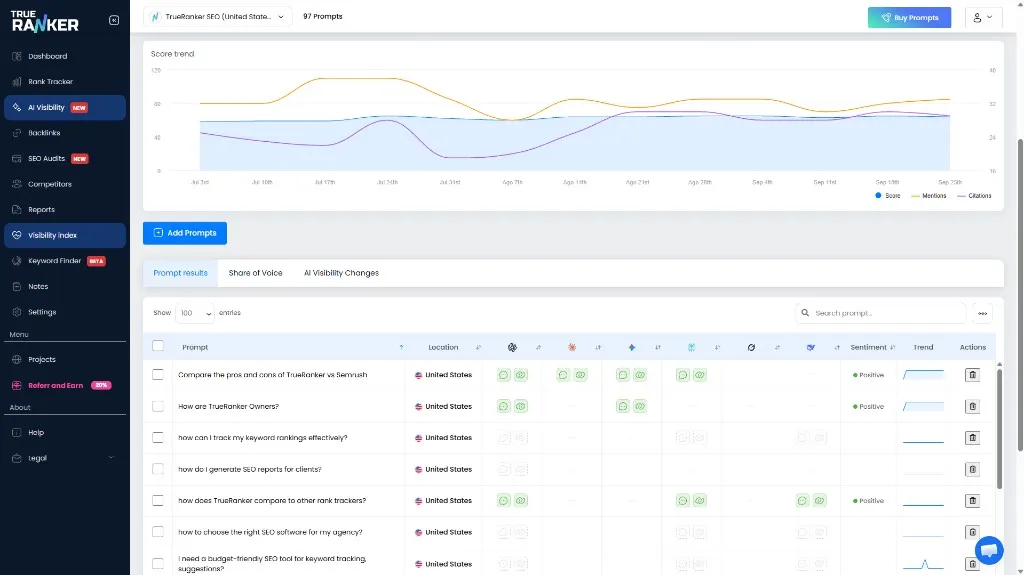
Mention versus citation, engine by engine, on the same tracked prompts.
I give it a week if the change was a paragraph. I don’t wait a quarter. If nothing moved, I don’t add a second change on top and call the bundle the test. I keep the first change and pick the next miss from the table.
Frequently asked questions
How often should I run an AI search optimization checklist?
I run the eight checks on a prompt when I’m about to change a page, and I rerun that prompt about a week later. I don’t run the whole table on every URL every Monday. The prompt you care about sets the cadence.
Is AI search optimization the same as SEO?
No. SEO still decides whether a page can be retrieved. This checklist decides whether an assistant used that page in one answer. You can rank and still miss the citation. You can get cited from a URL that never sat in the top three.
Does structured data make ChatGPT cite you?
No. Structured data can make a stated fact easier to parse. ChatGPT can still name you and cite someone else. I add markup for a fact I can see on the page. I don’t treat a green validator as a citation.
Can I guarantee ChatGPT will recommend my business?
No. I can tell you whether this prompt mentioned you, cited you, or skipped you, and whether that mark moved after one change. I can’t promise the next answer. Anyone who sells a guarantee is selling a guess.
How long before a change shows up in an AI answer?
I recheck about a week after a copy change. Some engines refresh faster than others. If nothing moved after that pass, I don’t assume I need to wait a month. I assume I picked the wrong miss, and I go back to the table.
Rerun the same prompt and see whether the citation moved.
Mentions and cited URLs sit in separate columns, so a name-drop doesn't look like a win.
Written by

Javier Quevedo
Co-Founder & CEO, SEO Lead
Javier co-founded TrueRanker and leads the frontend, the public website, and the last mile between a ranking in the database and the screen an SEO actually uses. He has spent years turning GEO, local SEO, on-page work and AI visibility into product — and into the guides on this blog — so agencies can measure ChatGPT citations the same way they already measure Google. He also works the backend: a clean interface over stale data is still a lie.
You might be interested
AI search ranking factors only count when a citation moves.
AI search ranking factors are why one page gets cited in ChatGPT or Perplexity and another does not. Here is what I check on a single prompt.
Javier Quevedo12 min read
Read the postWhy your Google ranking says nothing about your AI visibility
Ranking #3 on Google does not put you in ChatGPT's answer. Here is why the two came apart, and what to measure instead.
TrueRanker2 min read
Read the postWhat Is AI Brand Monitoring? (And Why It’s Crucial in 2026)
Discover what AI Brand Monitoring is, how it differs from traditional SEO, and how to use TrueRanker to measure your Share of Voice and more.
Javier Quevedo6 min read
Read the postAI Share of Voice: How to Tell if ChatGPT Recommends Your Competitors [2026]
Losing an LLM recommendation means losing a sale. Learn to measure Share of Voice against your rivals and read what ChatGPT says about you.
Javier Quevedo4 min read
Read the postAI Mentions vs Citations: The Key GEO Metric [2026]
Appearing in an AI response is not a binary goal. Learn the difference between a Brand Mention and a Citation, and why you need to measure both.
Javier Quevedo5 min read
Read the postGEO Guide 2026: 9 Steps to Optimize Your Website for ChatGPT & LLMs
Discover the 9 key tactics to get ChatGPT, Gemini, and Perplexity to recommend your brand. Shift from traditional SEO to GEO and dominate AI search.
Javier Quevedo6 min read
Read the post