What Is AI Brand Monitoring? (And Why It’s Crucial in 2026)
Discover what AI Brand Monitoring is, how it differs from traditional SEO, and how to use TrueRanker to measure your Share of Voice and more.

When a potential client goes to ChatGPT or Perplexity and asks: “What is the best invoicing software for SMBs?”, what does the AI answer?
If your product doesn’t appear in that personalized response, you are losing a customer in the highest-converting channel of the moment. There is no impression, no click, no chance to compete. The buyer simply accepts the LLM’s recommendation and moves on.
This is exactly the critical problem that AI Brand Monitoring solves.
What is AI brand monitoring?
AI brand monitoring is the practice of tracking when, how, and how often large language models (LLMs) mention or link to your company in the responses they provide to users.
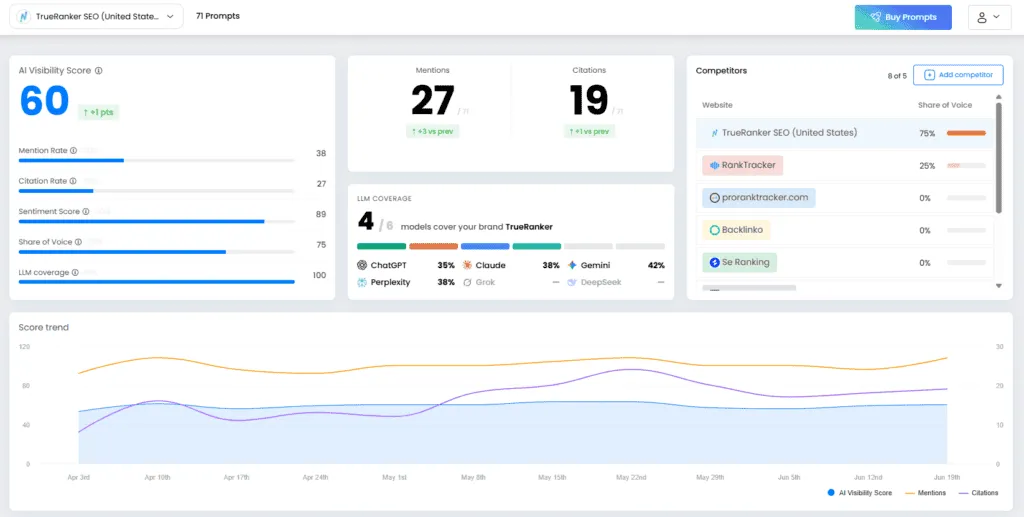
Unlike traditional SEO or social listening, it’s not about indexing static pages. It consists of sending structured queries (prompts) directly to the models’ APIs to audit in real-time whether your product is part of the AI’s active knowledge and whether its assessment of you is positive, neutral, or negative.
Real-world example: A cybersecurity company monitors the prompt “What tools prevent ransomware attacks on local servers?” across ChatGPT and Claude to verify if their brand is listed among the top 3 recommended options.
How does it differ from traditional monitoring?
Traditional monitoring tools (like Brand24 or Social Searcher) rely on scraping historical public feeds: Twitter/X posts, forums, blogs, or press news.
Generative AIs don’t work like that. An LLM’s responses are created on-demand in seconds; there is no static archive to crawl. Therefore, you need a tool that simulates human behavior by executing dynamic queries.
Approach Comparison Table
| Feature | Traditional Monitoring (Social/Web) | AI Brand Monitoring (TrueRanker) |
|---|---|---|
| Data Source | Forums, RSS, Social Media, News sites | Real-time responses generated by LLMs |
| Content Nature | Historical and static | Dynamic, ephemeral, and prompt-based |
| Main Metrics | Post volume, Likes, Estimated reach | Text mentions, Link citations, Share of Voice |
| Strategic Action | Respond to the user on the social network | Optimize the website (GEO) to influence the model |
Why might your brand be invisible in AI responses?
LLMs don’t invent their answers from scratch (unless they hallucinate). They rely on two pillars: their initial training data and RAG (Retrieval-Augmented Generation) systems, which allow models like Perplexity or Gemini to search Google in real-time to complement their responses.
If your brand doesn’t show up, it’s usually due to three main reasons:
- Lack of authority in your traditional SEO: If your key pages aren’t in Google’s Top 3 for informational terms, the AI’s RAG systems won’t read your content to build their answer. Your organic ranking directly influences your AI visibility.
- Lack of third-party coverage: AI models love consensus. If your brand is only mentioned on your own website, but doesn’t appear in industry media or review lists (G2, Capterra, press), the AI will assume you are not a relevant option.
- Lack of entity clarity: If your website doesn’t use flawless structured data markup (Schema), the AI might confuse your brand with another entity or fail to correctly categorize what problem you solve.
Key metrics you must measure (and how TrueRanker addresses them)
TrueRanker’s new AI Visibility module has redefined GEO analytics so you can stop guessing and start measuring with scientific data:
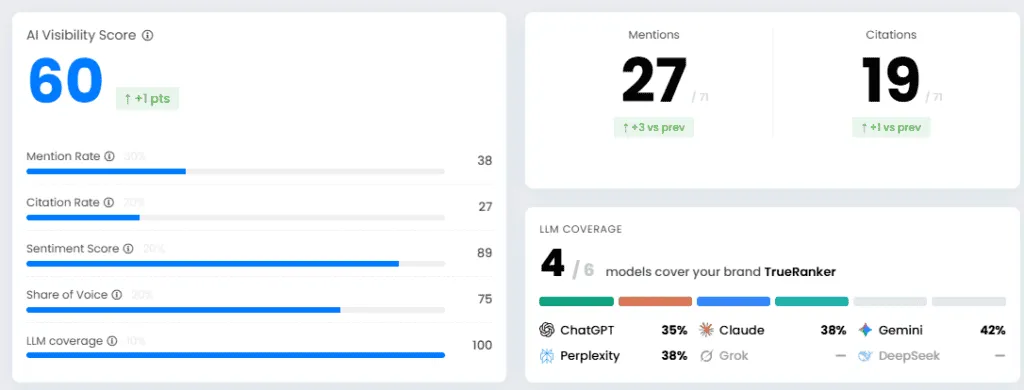
1. Mentions vs. Citations (The Queen Metric)
Not all credit holds the same value. TrueRanker separates these two concepts with surgical precision:
- Mentions: The AI names your brand in the text (excellent for branding and trust).
- Citations: The AI adds a direct hyperlink to your website as the source of the information. This is what truly drives direct referral traffic to your business.
2. Share of Voice (SoV) per Language Model
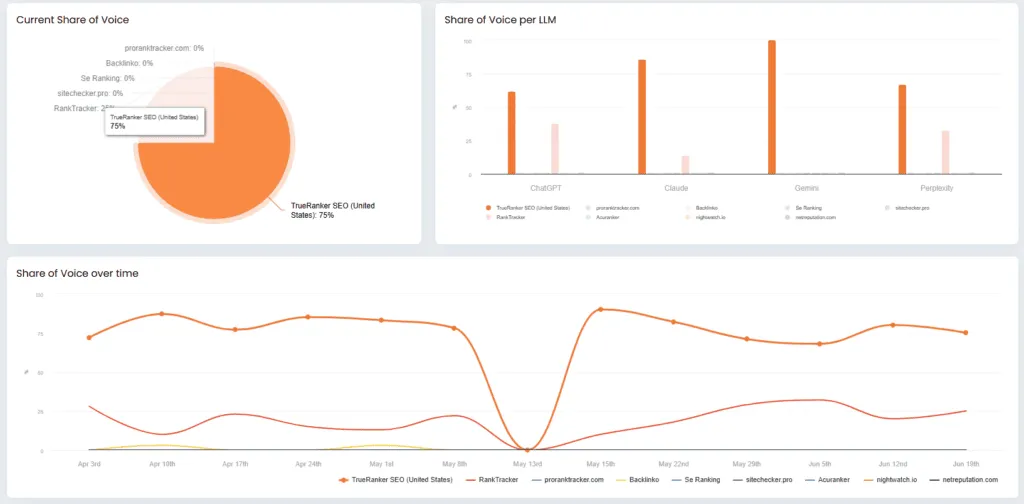
The market is fragmented. TrueRanker allows you to break down your visibility percentage in an interactive chart for each model: ChatGPT, Gemini, Claude, Perplexity, Grok, and DeepSeek. This way, you’ll know if you are the king on OpenAI but invisible to Google Gemini.
3. Literal Context Audit
A visibility score doesn’t tell you “why”. With TrueRanker, you can click on any tracked query and read the exact, literal response the AI gave, with your brand and your competitors highlighted. This allows you to analyze the sentiment and the sales arguments used by the model.
How to monitor your brand in AI step by step with TrueRanker
Step 1: Set up your commercial Prompt set
Instead of isolated keywords, think about real purchase intents. Translate your keywords into user queries:
- Classic Keyword: “Salesforce alternatives”
- AI Prompt: “What are the most affordable and easy-to-use alternatives to Salesforce in the real estate sector?”
Step 2: Choose the models you want to audit
From the TrueRanker dashboard, activate the strategic LLMs for your business. You can choose to track the combined response of all of them or focus on pure conversational search engines like Perplexity and Google AI Overviews.
Step 3: Analyze the competitive ecosystem
Enter the names of your top 3 or 4 direct competitors. The system will process the generated responses and grant you a conversational market share percentage (Share of Voice). If they appear 70% of the time and you only appear 10%, you’ll know it’s time to adjust your content strategy.
Step 4: Cross-reference with your traditional Rank Tracking
The magic of TrueRanker being a unified platform is that you can see the exact correlation: if your Google ranking goes up for an informational article, you will immediately see on the same dashboard how the Citations granted to you by Gemini or Perplexity for that same topic increase.
Strategies to improve your Generative Engine Visibility
Once TrueRanker shows you where you are falling short, the path to fixing it boils down to three tactical GEO (Generative Engine Optimization) actions:
- Dominate “Consensus Information”: Make sure to get mentions on third-party blogs and press releases. When an AI performs a real-time search via RAG and finds 4 independent sources saying your product is the best for “X” problem, the model will synthesize you into its final answer.
- Optimize for LLM formats: AIs love to structure their answers in bullet points, comparative tables, and pros/cons. Do the work for them: include clear tables on your product pages that compare your features and pricing against rivals. The AIs will extract those snippets directly.
- Monitor algorithm changes: LLMs update constantly (new versions of GPT or Claude are released regularly). Run weekly audits in TrueRanker to intercept sudden visibility drops before they impact your monthly lead volume.
Conclusion
AI brand monitoring is no longer an option for the future; it is an absolute necessity in 2026. If you blindly trust that your traditional SEO will protect your business in the browsers of tomorrow, you are leaving an open door for your competition.
With TrueRanker’s unified module, you get the perfect tool for the GEO era: a dashboard capable of tracking your classic Google rankings while auditing your mentions, citations, and Share of Voice inside generative AI with forensic precision.
Find out if your brand is visible to AI
With TrueRanker, you’ll have all the tools you need to become the most-mentioned brand in your industry
Written by

Javier Quevedo
Co-Founder & CEO, SEO Lead
Javier co-founded TrueRanker and leads the frontend, the public website, and the last mile between a ranking in the database and the screen an SEO actually uses. He has spent years turning GEO, local SEO, on-page work and AI visibility into product — and into the guides on this blog — so agencies can measure ChatGPT citations the same way they already measure Google. He also works the backend: a clean interface over stale data is still a lie.
You might be interested
The AI search optimization checklist I run before I change a page.
This AI search optimization checklist starts with one prompt. I show what to check, how to read a mention versus a citation, and when a change did nothing.
Javier Quevedo10 min read
Read the postAI search ranking factors only count when a citation moves.
AI search ranking factors are why one page gets cited in ChatGPT or Perplexity and another does not. Here is what I check on a single prompt.
Javier Quevedo12 min read
Read the postWhy your Google ranking says nothing about your AI visibility
Ranking #3 on Google does not put you in ChatGPT's answer. Here is why the two came apart, and what to measure instead.
TrueRanker2 min read
Read the postAI Share of Voice: How to Tell if ChatGPT Recommends Your Competitors [2026]
Losing an LLM recommendation means losing a sale. Learn to measure Share of Voice against your rivals and read what ChatGPT says about you.
Javier Quevedo4 min read
Read the postAI Mentions vs Citations: The Key GEO Metric [2026]
Appearing in an AI response is not a binary goal. Learn the difference between a Brand Mention and a Citation, and why you need to measure both.
Javier Quevedo5 min read
Read the postGEO Guide 2026: 9 Steps to Optimize Your Website for ChatGPT & LLMs
Discover the 9 key tactics to get ChatGPT, Gemini, and Perplexity to recommend your brand. Shift from traditional SEO to GEO and dominate AI search.
Javier Quevedo6 min read
Read the post