SEO tools: the kit that actually gets you found in Google
You want a list of SEO tools: names, what each one does, paid or free. I'll tell you which ten cover rankings, and how to see if ChatGPT names you.

If you’re searching for SEO tools, you want a list: names, what each one is for, which are paid and which are free.
This isn’t another ranking of twenty names nobody reads. Semrush, Ahrefs, Search Console and Screaming Frog are here because you actually use them. ChatGPT doesn’t belong here as a writer: writing isn’t ranking. Measuring whether it cites you is.
What SEO tools are (and what they aren’t)
They’re software and apps that measure or improve your visibility in search. A cache plugin or a text editor isn’t an SEO tool, even if it helps the site.
Yoast warns you about the title. Cloudflare makes the page load faster. ChatGPT drafts an H2. None of the three tells you whether you rank. Real search engine optimization tools cover rankings, keywords, audits, links or AI visibility. If they don’t give you a visibility number, don’t count them as SEO tools.
A couple of years ago a client showed me “his SEO stack”: Yoast, a redirect plugin and ChatGPT. He had 200 extra URLs, cannibalization on three landings and not one ranking measured. He’d bought tools to build the site, not tools to rank it.
The best SEO tools
These ten cover the real work. Five paid (one freemium), five free. TrueRanker is the SEO + AI suite I’d start with: rankings, backlinks, audits and whether ChatGPT cites you, in the same panel. Semrush, Ahrefs and SE Ranking also cover LLMs; they cost more and they win on keyword and link index.
| # | Tool | Best for | From |
|---|---|---|---|
| 1 | TrueRanker | SEO + AI visibility suite | $39/mo (billed annually) |
| 2 | Semrush | Suite: keywords, competitors and LLMs | $139/mo |
| 3 | Ahrefs | Suite: backlinks, keywords and LLMs | $119/mo |
| 4 | SE Ranking | SEO + GEO suite, simpler than Semrush | $109/mo |
| 5 | Screaming Frog | Technical audit (crawler) | Free up to 500 URLs |
| 6 | Google Search Console | Official impressions and clicks | Free |
| 7 | Google Analytics | On-site behavior, not rankings | Free |
| 8 | Keyword Planner | Keyword ideas from Google Ads | Free |
| 9 | Google Trends | Whether a term is rising or already dead | Free |
| 10 | PageSpeed Insights | Core Web Vitals, nothing to install | Free |
The best paid SEO tools
If you’re going to pay, pay for a job you’ll repeat every week. A suite “just in case” is the invoice I’ve seen wasted most often.
1. TrueRanker: SEO + AI visibility suite
The suite I’d start with. Rank tracker with a real city and device, backlink monitor, audits and AI visibility. It separates mentions from citations. Rankings and LLMs in the same panel, not a rank tracker with an add-on.
You start on Starter, from $39/mo billed annually. That plan measures ChatGPT, Perplexity, Gemini and Google AI Overviews. Claude, Grok and DeepSeek are on Pro. Rank tracker, backlinks, competitors and the rest of that suite sit on that plan too.
It doesn’t have Ahrefs’ backlink index or Semrush’s keyword database, but it has enough data and tools to run a project well.
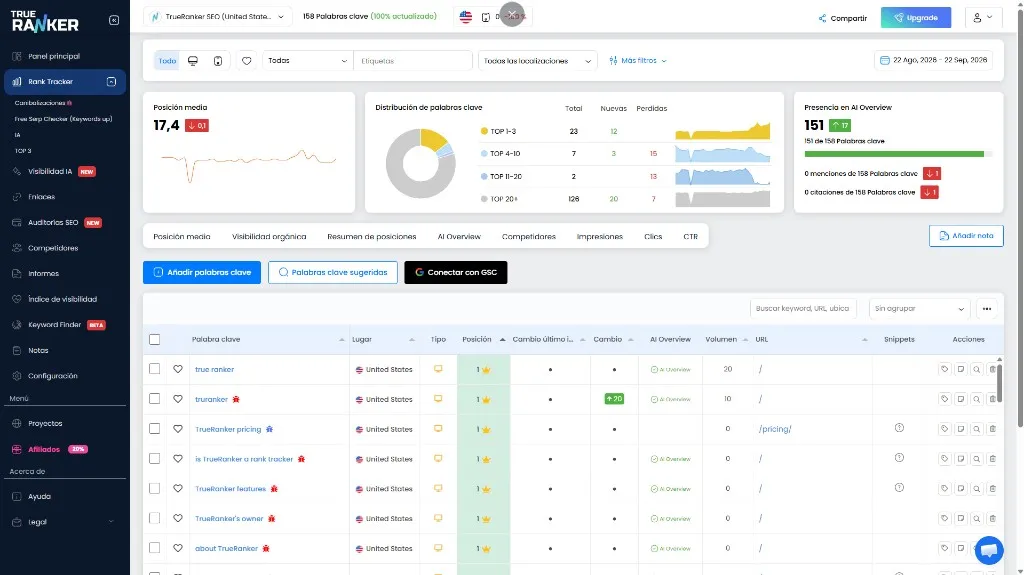
You can try it for 14 days, no card. If Starter isn’t enough, the rest of the plans are on pricing.
2. Semrush: the all-in-one SEO software
Semrush is the all-in-one SEO software most people mean, and for good reason: rank tracking, keywords, audits, competitors and LLM visibility. The cheapest SEO plan starts at $139/mo. If you want the AI features, the price goes up.
I’ve seen a freelancer pay it for a year to watch 40 keywords. If you’re an agency with big clients and you need a huge keyword and competitor database, it can be worth it. If you’re just starting, cheaper options will cover you.
3. Ahrefs: the backlink giant
Ahrefs wins when the question is “who links to this domain” or “what they rank for that I don’t”. Site Explorer and Keywords Explorer are why you pay. It also covers AI visibility (tracked prompts on Lite; Brand Radar is a separate product). Lite starts at $119/mo. The rank tracker exists, but it’s an extra, not why you subscribe.
For a one-off link check, the free backlink checker is enough. For the historical index and a real gap, Ahrefs (or Majestic) is still another league.
4. SE Ranking: the mid-price suite
SE Ranking does the same kind of work as Semrush, cheaper and simpler: rank tracker, keywords, audit, reports and GEO. Core starts at $109/mo and includes LLM visibility; the deeper AI Search block is an add-on. If you’re picking your first suite and Semrush feels too heavy, start here — unless you’re choosing on price and want something cheaper.
5. Screaming Frog: the crawler
Screaming Frog isn’t a suite. It’s the SEO tool that opens the site from the inside: duplicate titles, 404s, redirect chains, odd canonicals. Built for crawl errors. You can crawl 500 URLs on the free tier. A store with a handful of product pages eats that cap in an afternoon.
The mistake I see most: paying for it, running the audit, exporting 400 warnings and touching none of them. The crawler doesn’t replace an hour of fixing titles. If you’re starting and you don’t want to install the Spider, the free SEO audit gives you a first cut.
The best free SEO tools
These five are for diagnosis. You don’t build ranking history, and you don’t see whether Gemini cites you. That’s the ceiling, not a flaw.
6. Google Search Console
Google Search Console is the floor. Impressions, clicks, a historical average position, coverage, links Google has seen. Without this, the rest is just guesswork.
What it won’t do: tell you “today, in Chicago, on mobile, you’re fourth”. The historical average isn’t your customers’ rank. I wrote that up in why incognito mode lies to you. If you’re going to check every week, move to a rank tracker. If you only want a snapshot, the free SERP checker.
7. Google Analytics
Google Analytics tells you what people do on the site: channels, conversions, visits. It isn’t a ranking tool. People put it on these lists because without it you don’t know whether the traffic GSC promises converts. GSC and Analytics go together. Analytics alone doesn’t tell you whether you rank.
8. Google Ads Keyword Planner
The Keyword Planner in Google Ads is still the official source of search volumes. The numbers come from people who advertise, not people who rank: useful for a search range, not for inventing a keyword or reading SEO difficulty. That product is built for bids.
On a small project, most keywords worth attacking already sit in Search Console: queries with impressions and almost no clicks. A clinic wanted to rank for “dental implants”. Impossible. Their Search Console had 90 impressions a month on “dental implants without bone graft” plus the city. That string didn’t show up in any keyword tool. It was in their own console.
If you want to go further, how to get keyword ideas and how to read a competitor’s keywords.
9. Google Trends
Google Trends won’t give you actionable volume. It’ll stop you fighting a term that already died, or show you that “chatgpt seo” has eaten the 2019 query. Free, fast, official. One of the ranking tools people skip because it doesn’t look “SEO”.
10. PageSpeed Insights
PageSpeed Insights measures Core Web Vitals with nothing to install. Don’t obsess over 100. Do find out if LCP is broken: if the page doesn’t load, the content doesn’t matter.
The free SEO tools hub puts ours in one place (SERP, audit, backlinks, comparison, AI visibility) without asking for a card. When the free ceiling hurts (history, competitors, LLMs), you pay. Not before.
Measuring whether ChatGPT cites you isn’t the same as writing
Generating copy with AI isn’t a ranking tool. Writing helps. It doesn’t tell you whether the model recommends you. Measuring whether ChatGPT, Gemini or Perplexity names you or cites you is a ranking job, and a different one. That’s why TrueRanker is first on this list and “ChatGPT” or Surfer aren’t.
This isn’t theory. One of our lawyer clients ranks third on Google for an expensive divorce term. I asked ChatGPT “best divorce lawyer in New York”, without naming the firm, and the model recommended a competitor who sits eighth on Google. Rankings don’t predict the citation. I unpacked that in AI visibility vs Google rankings.
An AI visibility tool does three things Search Console won’t give you:
- Re-runs your customers’ prompts (not your keywords) on several engines.
- Separates mention (it names you) from citation (it links to your site).
- Lets you read the answer, not only a number.
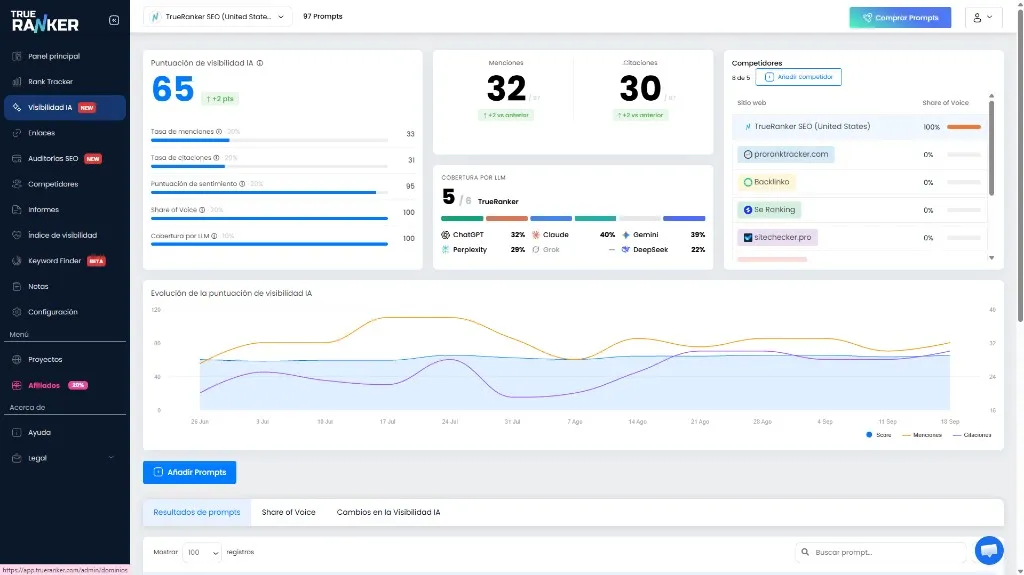
If you only want a first look at one URL, the AI visibility checker is the shortcut. If an SEO tools list doesn’t measure whether ChatGPT cites you, it’s a 2022 kit.
SEO software or a loose kit: when each one is enough
A suite covers several jobs with one login. A kit (Search Console + crawler + rank tracker) is cleaner if you won’t use 80% of the suite.
Three signs the kit is enough: you have one or three sites, keyword research already comes from GSC, and you don’t ship white-label reports every Monday.
Three signs the suite actually saves time: you spend a lot of time doing keyword and link gap analysis, you have several clients and countries, and switching tabs is costing more than the price difference.
Neither the kit nor the suite is “more professional”. The professional is the person who stops paying for buttons they never touch.
How to put together a web-ranking tools stack
Start with Search Console and a suite. TrueRanker covers rankings, backlinks, audits and AI visibility. Add a crawler when you have dozens of URLs. Add Ahrefs or Semrush the day you need their index, not the first Monday. You pick ranking tools by this week’s question, not by the feature PDF.
Freelancer or small business
For day-to-day operations, I’d use GSC + Analytics, TrueRanker as the SEO + AI suite, and Screaming Frog once you pass a few dozen URLs. Semrush and Ahrefs can wait until the big index is the bottleneck.
Agency or in-house team
Operating suite (the one you use every week): TrueRanker for rankings, AI visibility, backlinks and audits, plus Search Console on every property. If you report to clients, this layer is the product.
Research index (the one you use in bursts): one of the expensive suites (Semrush or Ahrefs or SE Ranking, not all three) for keyword and link gaps, a crawler at scale, the free SEO comparison when a prospect walks in.
Three suites at once is paying for keyword research three times. Pick TrueRanker to operate and, if you need it, one for the index.
Three questions before you pay for SEO software
You can diagnose without paying. For history, competitors and what the chats answer, the free ceiling shows up in weeks, not years.
Do you need a paid tool?
No, for duplicate titles or a landing that loads badly. Yes, the day you need the same measurement, on a schedule, without sitting there yourself. That’s a rank tracker. That’s an AI citation monitor. Incognito doesn’t do that.
One suite or several specialists?
A suite if you want rankings, AI, backlinks and audits in one login. TrueRanker covers that job; Semrush or Ahrefs, the index. Several specialists if the real work is a crawler plus GSC and nothing else. Mixing three suites “just in case” is the expensive mistake.
What if you only care about Google?
Then the kit is Search Console + rank tracker + crawler. I still leave AI visibility on the list because “Google only” lasts until your customers ask a chat. The day they do, it isn’t another suite. It’s another job, with another metric.
Measure Google and ChatGPT in the same panel
14-day trial, no credit card. Rankings, backlinks and AI visibility, together.
Written by

Javier Quevedo
Co-Founder & CEO, SEO Lead
Javier co-founded TrueRanker and leads the frontend, the public website, and the last mile between a ranking in the database and the screen an SEO actually uses. He has spent years turning GEO, local SEO, on-page work and AI visibility into product — and into the guides on this blog — so agencies can measure ChatGPT citations the same way they already measure Google. He also works the backend: a clean interface over stale data is still a lie.
You might be interested
8 Best SE Ranking Alternatives in 2026 (AI Visibility Focus)
Looking for SE Ranking alternatives in 2026? Discover the top 8 tools to track your AI visibility and GEO metrics, led by TrueRanker.
Javier Quevedo7 min read
Read the post