The 7 Best ChatGPT Trackers in 2026 (Rank & Visibility Tools Compared)
Compare the best ChatGPT trackers in 2026. Discover how top tools measure brand mentions, citations, Share of Voice, and literal answers in AI search.

It has already happened to you.
You open ChatGPT. You type the exact question your best prospect asked you yesterday: “What is the best rank tracker for a five-person agency?”
Your direct competitor is right there in the first paragraph. You are not. Not in the summary. Not in the footnote links. Nowhere.
You hit regenerate. Different wording, same verdict: your brand does not exist in the synthesized answer.
In Google, sitting at position 4 still brings you 7% of search clicks. In ChatGPT, position 4 does not exist. You are either named in that final paragraph, or you are invisible.
I have spent years building rank tracking software and monitoring how LLMs digest websites. My honest take: checking this by hand is a waste of time. Large language models are non-deterministic. A prompt tested on your home Wi-Fi today will return a different citation set from an office IP tomorrow.
You need automated tracking. But you do not need another enterprise tool charging you $300 a month for shallow vanity metrics.
Here is my direct breakdown of the 7 best ChatGPT tracking tools in 2026, what they measure, where they break, and which one you should actually set up this week.
Quick Comparison: The 7 Best ChatGPT Trackers in 2026
| Tool | Best for… | Starting Price | Models Tracked | Mentions vs. Citations | Literal Response Audit |
|---|---|---|---|---|---|
| 1. TrueRanker | GEO + SEO hybrid tracking | $39/mo | ChatGPT, Gemini, Claude, Perplexity, DeepSeek | Strict separation | Full verbatim & highlights |
| 2. Peec AI | Agencies & clean UI | €89/mo | ChatGPT, Claude, Perplexity, Gemini | Yes | Yes |
| 3. Otterly AI | Fast, lightweight checks | $29/mo | ChatGPT, AI Overviews, Perplexity | Basic | Partial |
| 4. Profound | Enterprise scale & compliance | $99/mo | 10+ models (ChatGPT, Copilot, Grok) | Yes | Yes (Enterprise) |
| 5. Rankscale AI | High-frequency sampling | $20/mo | ChatGPT, Claude, Gemini, Perplexity | Basic | Yes |
| 6. SE Ranking | Teams with existing SEO suite | ~$79/mo | ChatGPT, Gemini, Copilot, AI Overviews | Partial | Limited |
| 7. Mencoro | Agile teams & SMBs | €15/mo | ChatGPT, Perplexity, Claude, AI Overviews | Yes | Yes |
What Does a ChatGPT Tracker Actually Measure?
Traditional rank tracking is simple: a keyword goes in, a numeric SERP rank comes out.
ChatGPT tracking does not work that way. The unit of work is a conversational prompt, not a keyword.
To give you data you can actually act on, a tracker must separate fact from fluff across five specific metrics:
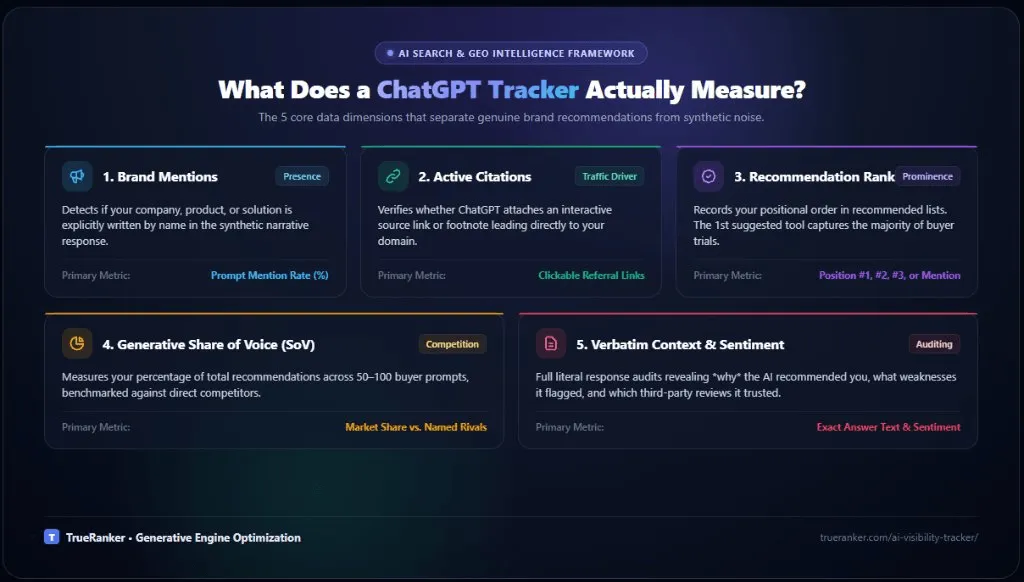 The 5 core dimensions a ChatGPT tracker must measure: from simple brand mentions to active, clickable source citations.
1. Brand Mentions (The Name on the Screen)
Did ChatGPT explicitly write your brand or product name in its generated answer? This tracks raw conversational awareness.
2. Active Citations (The Referral Link)
A mention is brand awareness. A citation is referral traffic. When ChatGPT searches the web, it attaches clickable pills or footnote numbers. If your URL is linked, the model treats your domain as a primary authority.
It is not X. It is Y. Being named in a paragraph is not a citation. A citation is a verified source link.
3. Recommendation Rank
When an LLM recommends four tools, the first one gets tested. The fourth one gets ignored. The tracker must record whether you were position #1 or an afterthought in the final bullet point.
4. Generative Share of Voice (SoV)
Out of 50 core buyer prompts (“best alternatives to X”, “affordable tool for Y”), what percentage of answers feature your brand versus your rivals?
5. Verbatim Response Audit
A dashboard counter that says “10 mentions” is useless if three of those mentions say your software is overpriced and buggy. You must be able to read the literal response the model produced.
1. TrueRanker: Best Overall ChatGPT & AI Visibility Tracker
I co-founded TrueRanker because I was tired of watching legacy SEO platforms treat AI search as an overpriced, afterthought add-on.
TrueRanker bridges the gap: you track your classic Google rankings down to the city and zip-code level, and right next to it, you audit your brand presence across ChatGPT, Gemini, Claude, and Perplexity.
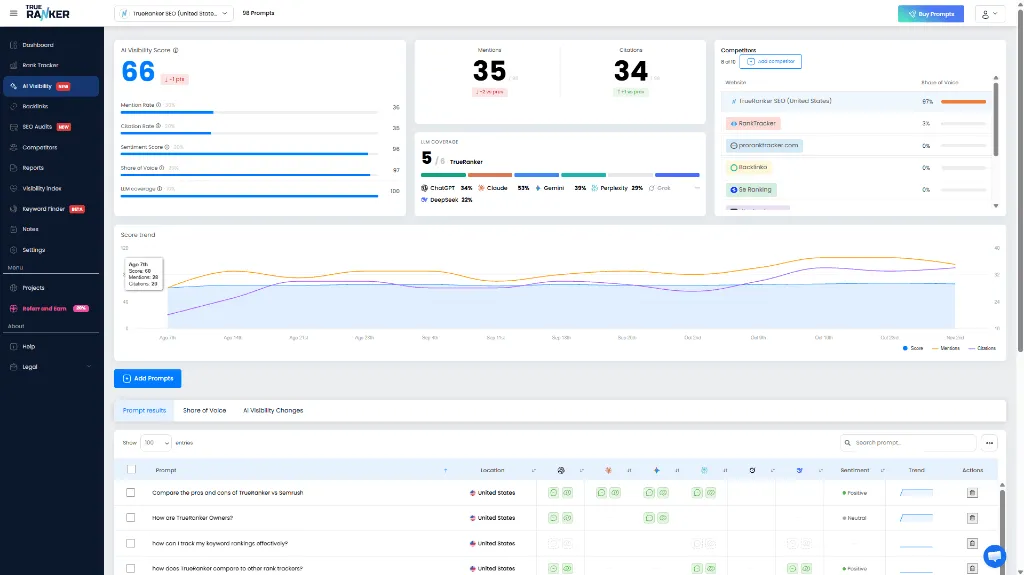 TrueRanker AI Visibility dashboard: visibility score, active citation breakdown, and competitive Share of Voice over time.
Why It Stands Out
Most platforms lump mentions and citations together to inflate their dashboards. We do not.
TrueRanker isolates both metrics cleanly:
- Mentions: You know when the model speaks your name.
- Citations: You know when the model attaches a direct link to your site.
When you click on any prompt in your project, TrueRanker opens the literal response modal. You see the exact text ChatGPT generated, with your brand and your competitors highlighted in distinct colors. No guessing. No synthetic summaries.
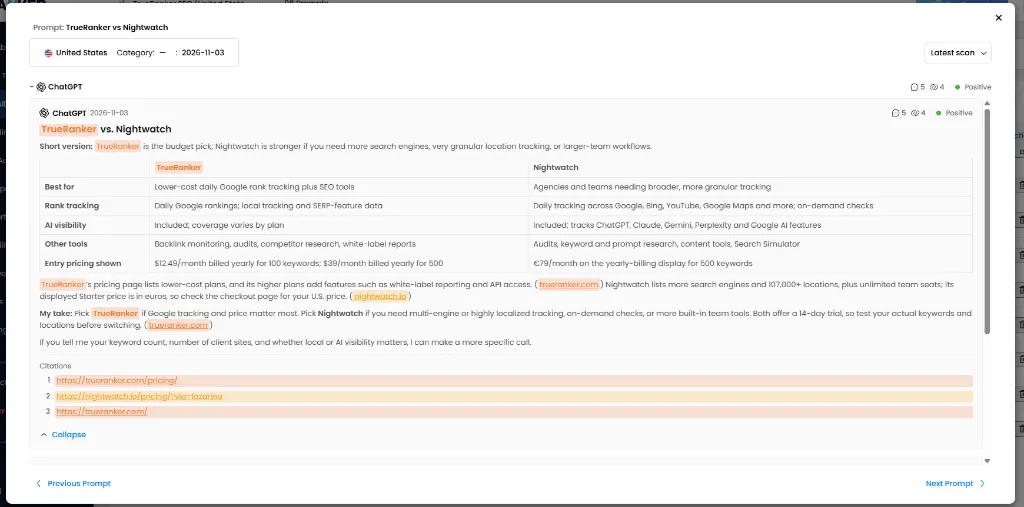 Inspecting the literal answer generated by ChatGPT inside TrueRanker, with competitor mentions highlighted.
Key Features
- Multi-Model Coverage: Track ChatGPT (including web search mode), Google Gemini, Claude, Perplexity, Grok, and DeepSeek in one project.
- Competitor Share of Voice: Add up to 10 competitors and watch your market share line move week over week.
- Literal Answer Audits: Read the raw answer text to inspect sentiment and context before making content changes.
- No Tier Gimmicks: Both Google rank tracking and AI visibility tools are included starting at $39/month.
Watch-Outs
- TrueRanker is an auditing and rank-tracking engine. We do not generate AI blog posts or rewrite your copy automatically.
Pricing
Plans start at $39/month, covering both hyper-local Google rank tracking and multi-model AI visibility.
2. Peec AI: Best for Dedicated European Agencies & Boutique Teams
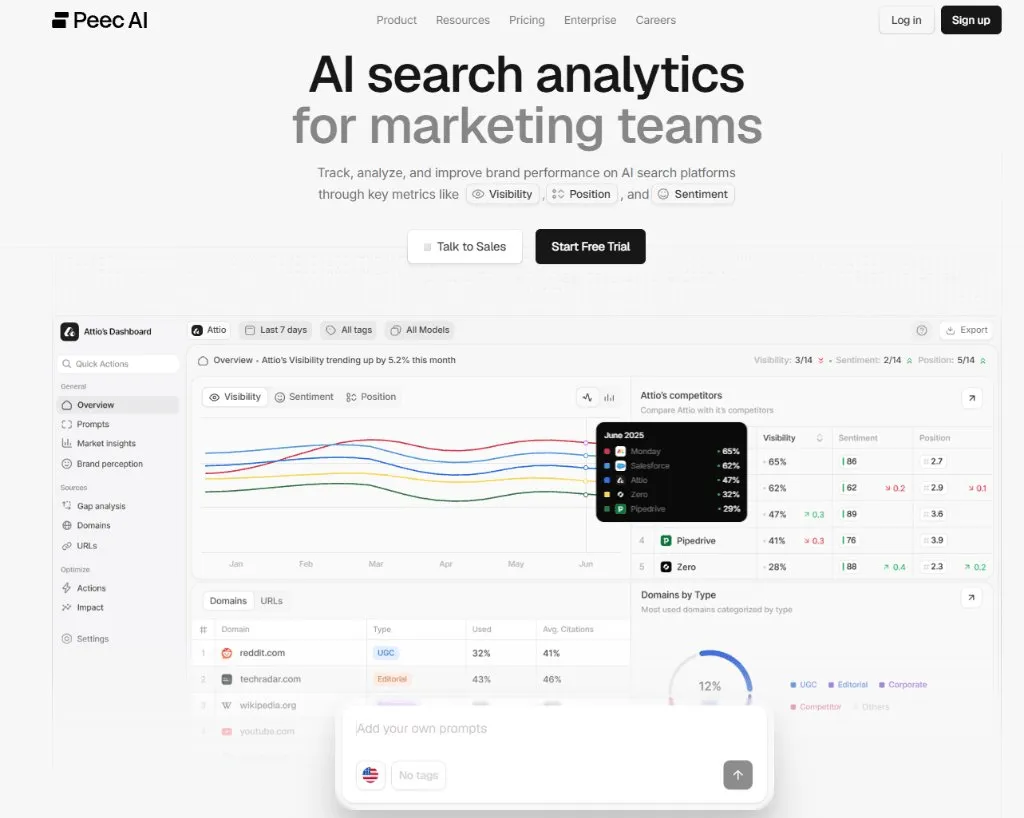
Peec AI is a focused European platform built specifically for monitoring AI answers across ChatGPT, Claude, and Perplexity.
Why It Stands Out
Peec AI has a clean, well-designed interface and avoids reliance on bare API endpoints. It scrapes web-facing results that reflect what actual users see in their browsers, making its reports reliable for client meetings.
Key Features
- Tracks sentiment, citations, and positional visibility across major LLM platforms.
- Regional prompt testing for European and US markets.
- Clean client-facing reporting exports.
Watch-Outs
- Price jumps substantially. The starter tier begins around €89/month for 50 prompts, but testing larger prompt sets across three or four engines quickly pushes you onto plans of €245/month or higher.
- Zero traditional Google rank tracking. You will need a second tool for your standard SEO.
Pricing
From €89/month (~$95/mo) for 50 prompts, up to €245/month for 150 prompts across three engines.
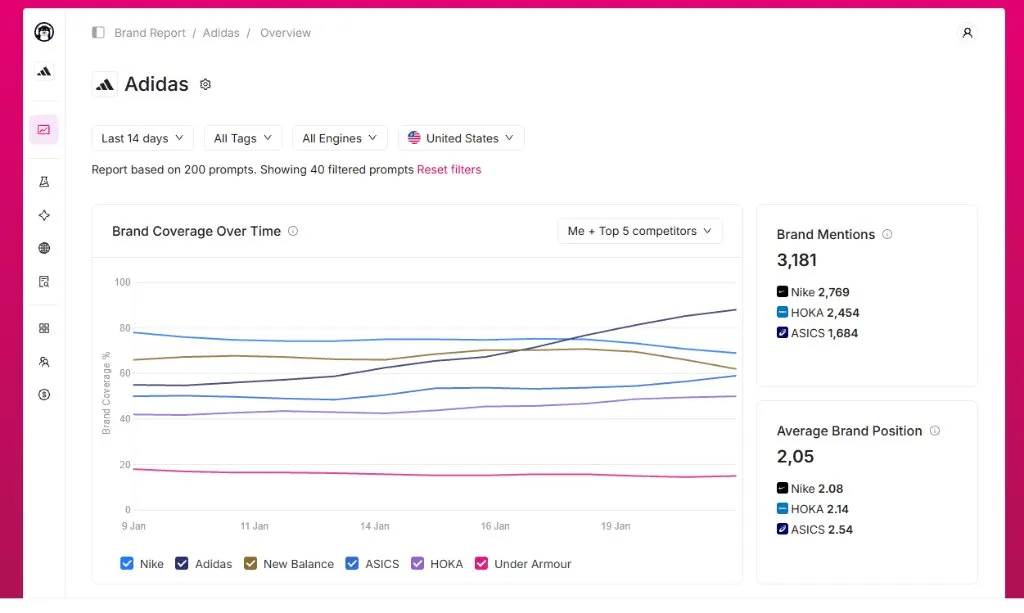
3. Otterly AI: Best for Lightweight, Budget-Friendly Spot Checks
If you simply want a quick, low-effort check to see if your brand registers on ChatGPT, Otterly AI is a simple entry point.
Why It Stands Out
There is almost no setup. You enter your domain, add a handful of prompts, and Otterly generates a basic visibility score across ChatGPT, Google AI Overviews, and Perplexity.
Key Features
- Very fast setup with minimal onboarding friction.
- Basic email alerts when your brand disappears from a tracked prompt.
- Low starting price for solo founders.
Watch-Outs
- The data is shallow. It does not provide granular citation source analysis or deep competitor text comparisons.
- Historical data retention is short on lower tiers.
Pricing
Starts at $29/month for entry-level prompt sets.
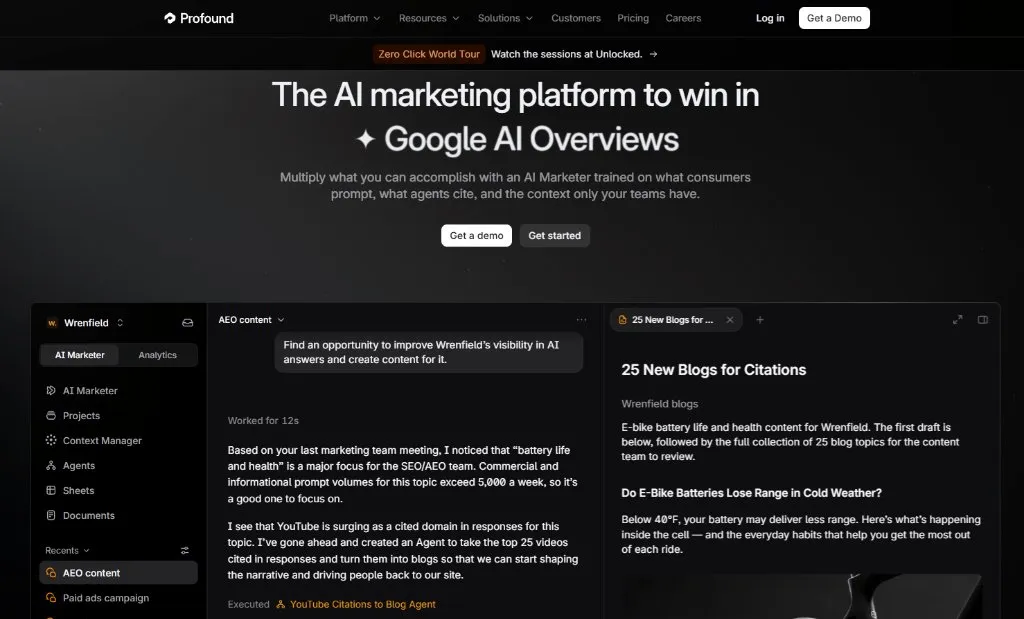
4. Profound: Best for Enterprise Scale & Corporate Compliance
Profound is built for enterprise corporations with large legal and compliance budgets (think Ramp, Figma, and Fortune 500 teams).
Why It Stands Out
Profound monitors thousands of prompts simultaneously and maintains a massive index of real user queries. It also monitors your server logs to show when bots like GPTBot or Google-Extended crawl your site.
Key Features
- Monitors 10+ engines, including enterprise surfaces like Microsoft Copilot and Grok.
- AI bot crawler analytics directly from your CDN/server logs.
- SOC-2 Type II certified with custom enterprise SSO.
Watch-Outs
- Completely out of reach for freelancers and boutique agencies. While the base plan starts at $99/month, useful enterprise configurations routinely cost thousands per month.
Pricing
From $99/month for Starter; customized enterprise plans range from $500 to $2,500+/month.
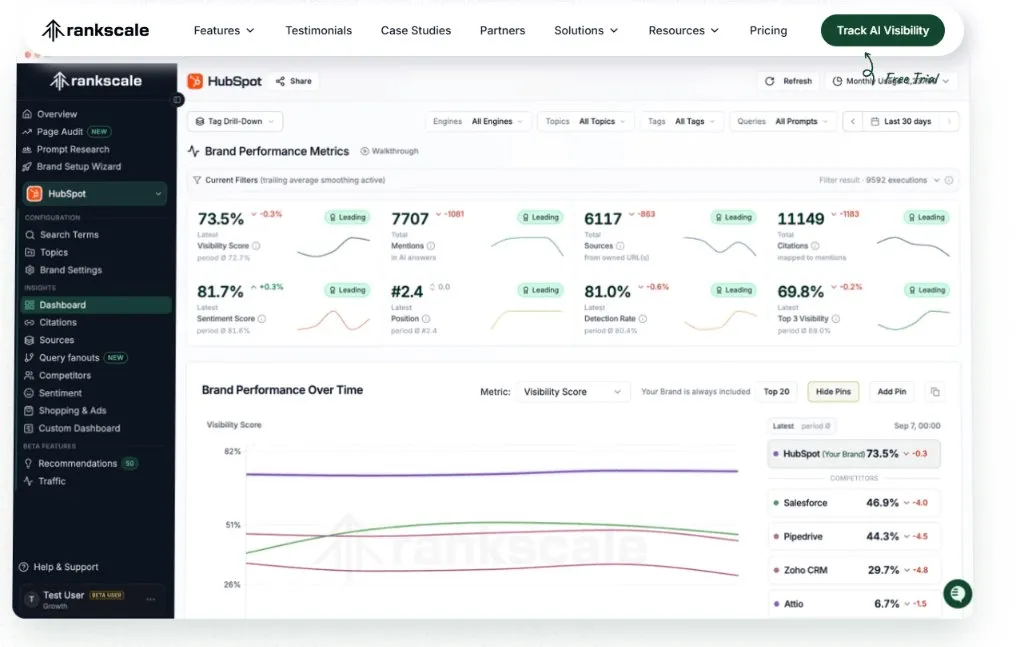
5. Rankscale AI: Best for High-Frequency Sampling
Rankscale AI is designed for technical SEOs who want to monitor answer volatility across hourly and daily intervals.
Why It Stands Out
Most trackers refresh once a week or once a day. Rankscale lets you adjust execution cadences down to hourly runs, which is helpful if you are launching a PR campaign or tracking a major product update.
Key Features
- Multi-engine tracking covering ChatGPT, Perplexity, Claude, and Gemini.
- Configurable scheduling per prompt.
- Volatility tracking indices.
Watch-Outs
- The credit consumption model is easy to burn through. Running 50 prompts hourly across four engines will exhaust your plan within days.
- Interface feels like a raw developer database rather than an executive dashboard.
Pricing
Starts at $20/month, scaling up to $99/month (Pro) and $385/month (Growth).
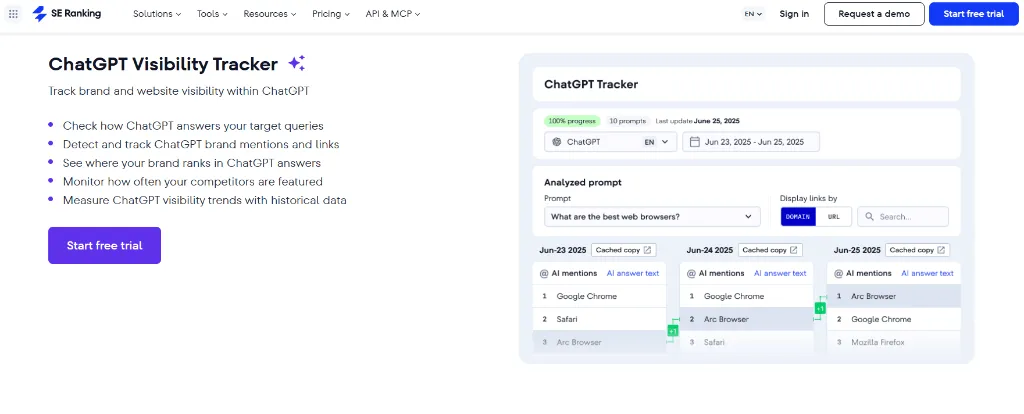
6. SE Ranking (SE Visible): Best for Existing SE Ranking Power Users
If your team is already locked into SE Ranking for audits, backlinks, and keyword tracking, their “SE Visible” module adds basic AI monitoring to your existing dashboard.
Why It Stands Out
It keeps your team in one tool. You see your traditional Google rankings and your AI presence on the same screen.
Key Features
- Tracks ChatGPT, Gemini, Copilot, and Google AI Overviews.
- Unified agency reports merging SEO rankings and AI checks.
- Familiar UI for existing SE Ranking users.
Watch-Outs
- It is not included in the standard subscription. You pay your regular SE Ranking fee and then purchase an additional monthly subscription for SE Visible credits.
- Literal answer audits and citation analysis are limited compared to dedicated GEO tools.
Pricing
Requires an active SE Ranking plan (from ~$55/mo) plus the SE Visible add-on, bringing the true entry cost to $79–$110/month.
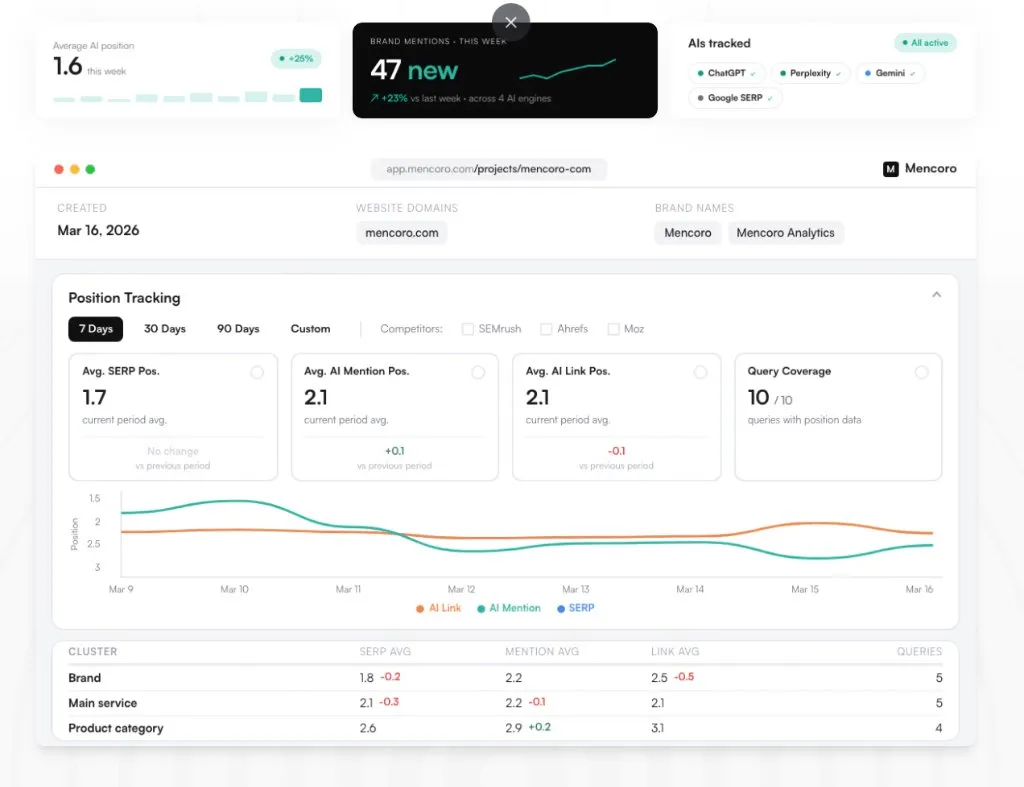
7. Mencoro: Best for Agile SMBs and Freelancers
Mencoro is an independent platform from Barcelona focused on clean, accessible AI visibility tracking for European small businesses and consultants.
Why It Stands Out
Mencoro has no arbitrary project caps. You can create projects for different domains and test prompts in English and Spanish without paying enterprise penalties.
Key Features
- Unlimited projects and unlimited competitors on all plans.
- Multi-language engine tracking across ChatGPT, Perplexity, Claude, and AI Overviews.
- REST API and MCP server support for developer workflows.
Watch-Outs
- Focuses strictly on national and international visibility; it does not do local city-level rank tracking.
- Does not offer classic Google SEO tools (backlinks, technical audits).
Pricing
Starts at €15/month (~$16/mo) for 10 prompts checked weekly across five engines, with mid-tier plans at €29/mo and €49/mo.
The Technical Trap: OpenAI API vs. Real ChatGPT Search
Before you buy any ChatGPT tracker, ask the vendor one question:
Are you pinging the raw OpenAI API, or are you scraping the live ChatGPT Search web interface?
Many budget tools take the lazy path: they connect an API key to gpt-4o and run your prompt.
That gives you faulty data for three reasons:
- Static Weights vs. Live Web: Standard API calls answer from trained weights and training cutoffs. The real ChatGPT interface uses live web search to pull fresh facts.
- Missing Citations: The live ChatGPT interface inserts interactive source pills and footnote citations. A basic API call often omits citations entirely.
- Location Blindness: An API call runs from an anonymous cloud data center. The live consumer interface respects geographic intent and browser localization.
If a tool is only querying the bare API, it is not tracking what your potential buyers actually see. At TrueRanker, we run real-world browser simulations with full citation extraction so the data matches reality.
What to Do This Week: A Pragmatic 4-Step Action Plan
Do not overcomplicate your first audit. Here is the exact order of operations I recommend:
- Write your 15 core buyer prompts. Do not paste keywords. Write the literal questions your customers ask before buying (e.g., “Best [tool category] for [your niche]”, “Top 3 alternatives to [main competitor]”).
- Add your top 3 direct competitors. You cannot understand your visibility in a vacuum. Track your Share of Voice against the rivals winning your market.
- Inspect the literal response. Look at where the AI sourced its answer. Did it cite an independent review site? A Reddit thread? A comparison blog post? That cited URL is your next digital PR target.
- Track weekly, not hourly. AI answers fluctuate naturally. Checking every hour creates panic over normal statistical variance. Track weekly to spot true algorithmic trends.
Frequently Asked Questions
What is the difference between a brand mention and a citation in ChatGPT?
A brand mention is plain text: the model writes your company name. A citation is an active link or footnote pointing to your website. Citations drive real referral clicks and prove that the model treated your domain as a primary factual reference.
Can I track ChatGPT rankings using Google Search Console?
No. Google Search Console only measures traffic from Google-owned properties (Search, Discover, Images, Video, and Google AI Overviews). It has zero access to queries inside OpenAI’s ecosystem.
How often does ChatGPT change its answers?
Because LLMs generate text probabilistically, answers vary slightly between runs. However, the core cited domains and top-recommended brands remain relatively stable week to week unless new authoritative content enters the search index.
Stop Guessing What ChatGPT Tells Your Buyers
The transition from 10 blue links to conversational AI answers is the biggest shift in search since Google displaced Yahoo.
You can either ignore it and wonder why direct traffic is slowing down, or you can track your position, protect your brand, and reverse-engineer the sources the AI trusts.
If you want an honest, powerful platform that tracks both your Google SERP rankings and your ChatGPT visibility without enterprise price gouging:
Audit your brand today with TrueRanker’s AI Visibility Tracker.
Is ChatGPT recommending your brand or your competitors?
Audit your Share of Voice, citations, and literal prompt responses across ChatGPT and major LLMs today with TrueRanker.
Written by

Javier Quevedo
Co-Founder & CEO, SEO Lead
Javier co-founded TrueRanker and leads the frontend, the public website, and the last mile between a ranking in the database and the screen an SEO actually uses. He has spent years turning GEO, local SEO, on-page work and AI visibility into product, and into the guides on this blog, so agencies can measure ChatGPT citations the same way they already measure Google. He also works the backend: a clean interface over stale data is still a lie.
You might be interested
The 10 Best White Label SEO Software Platforms in 2027 (Ranked for Agencies)
Compare the 10 best white label SEO software platforms in 2027. Discover agency pricing, hidden add-ons, Google tracking, and AI search reporting.
Javier Quevedo13 min read
Read the postBest Black Friday SaaS Deals (2026): Practical Tools for Growth
Looking for real Black Friday 2026 SaaS deals without affiliate fluff? Explore top software discounts or submit your tool for a reciprocal featured spot.
Javier Quevedo76 min read
Read the post11 Best SEO Chrome Extensions in 2026 (Tested for Speed & Workflow)
Most SEO Chrome extensions bloat your browser. Here are the 11 tools I actually keep pinned for on-page audits, redirects, SERPs, and schema.
Javier Quevedo14 min read
Read the postAI SEO tools: writing is not the same as measuring if they cite you
Looking for the best AI SEO tools in 2026? Compare the top tools for drafting, on-page audits, and tracking whether ChatGPT & Gemini cite your site.
Javier Quevedo9 min read
Read the postSEO tools: the kit that actually gets you found in Google
You want a list of SEO tools: names, what each one does, paid or free. I'll tell you which ten cover rankings, and how to see if ChatGPT names you.
Javier Quevedo10 min read
Read the post8 Best SE Ranking Alternatives in 2026 (AI Visibility Focus)
Looking for SE Ranking alternatives in 2026? Discover the top 8 tools to track your AI visibility and GEO metrics, led by TrueRanker.
Javier Quevedo8 min read
Read the post