Google is serving rank trackers pages that look real and aren't
Since September 2026, Google has been handing rank trackers normal-looking pages with the wrong results. Here is how to tell that from a real drop.

A poisoned SERP is a complete Google results page whose sites have been swapped. Nothing on the page says so. No error, no captcha, the same template.
Since September 2026, Google has been handing some of those pages to rank trackers. The number only means something if I say which measurement it came from, and on which dates.
Depends how you measure it.
A normal-looking page can still be wrong.
A poisoned SERP is a complete page with the wrong sites
A poisoned SERP isn’t a block, and it isn’t a captcha. It’s a finished page, and most of the keyword’s usual sites are missing.
Nozzle’s study, published October 10 with data through October 9, calls a SERP poisoned when fewer than half of that keyword’s usual sites show up on any page, and those sites come back on a later fetch. Usual sites are the ones in the top 10 on at least 60% of the keyword’s SERPs from August 20 to September 9, and only keywords with five or more fetches in that window get judged.
The page looks normal, and that’s the problem
A refused request tells the scraper to try again. A poisoned page gets stored as the ranking.
That’s what showed up in our fetches when this started. Google had spotted the scraper and sent back results that didn’t match the query. No banner. The row still looked like a position.
A refused request is not a ranking.
Requests failed on September 13, then the results came back wrong
Requests to Google started failing in large numbers on September 13. The pages that still came through stayed normal until September 20, when poisoned SERPs first show up. From September 13 through October 9, 8.0% of judged SERPs were poisoned, against 0.17% in the August 20 to September 9 baseline. On September 27, 28 and 29 it was about a quarter of that day’s SERPs: 24.9%, 26.7% and 27.0%. The study covers 27.5 million SERPs, 49 countries, desktop, iPhone and Android.
Derek Perkins at Nozzle described three moves to Search Engine Roundtable on October 12: wide blocking of residential proxy ranges, a lot more captchas, and bad results injected into SERPs the request looks suspicious on.
Google hasn’t confirmed any of it. Barry Schwartz’s read, in that article, is that the target is AI bots and SerpApi, not SEO tools. Rank trackers collect SERPs the same way, so the bad pages land here too. I don’t have a separate measurement of the motive, so I won’t invent one.
| What changed | Baseline, Aug 20 to Sep 9 | Since September 13 |
|---|---|---|
| Poisoned SERPs | 0.17% | 8.0% |
| Previous top-10 sites gone, per SERP | 0.23 | 1.79 |
| Organic sites kept from the previous SERP | 88.5% | 20.7% |
| Tracked site missing the top 10 | 2.7% | 58.6% |
| Usual sites back within three days | n/a | 77.9% |
Those figures are Nozzle’s, through October 9, 2026. A SERP counts as poisoned only after the usual sites come back, so the last days of their chart were still filling in when they published. The 58.6% is against a 2.7% baseline, and against 10.2% on the same keywords’ other SERPs since September 13. It isn’t “every tracked site fell off.”
Nozzle’s 8% is one measurement.
Forums fill the gaps, and the paid blocks stay put
On a poisoned SERP the organic results keep 20.7% of the previous SERP’s sites, against 88.5% in the baseline. Forums and social sites take a lot of the space those sites leave. Same keywords, since September 13, share of top 10s:
- Reddit, 20.8% on the keyword’s other SERPs, 28.8% on the poisoned ones
- Facebook, 28.3% to 33.8%
- LinkedIn, 6.2% to 9.3%
- Instagram, 9.6% to 12.1%
- Quora, 5.3% to 6.7%
YouTube goes the other way, 16.3% to 13.9%. So do Yelp (12.9% to 11.1%) and MapQuest (4.2% to 3.5%).
One keyword makes the swap obvious. “white label local seo”, desktop, United States. October 4 is a page of white-label SEO vendors. October 7, same query, same device, same country, 9 of 9 page-1 sites are gone. In their place: a local WordPress tool, a Jackson Hole steakhouse, a directory of county health departments, USA.gov. Pagination drops from 10 pages to 3. Page-1 results drop from 45 to 26. The HTML stays about the same size, 720 KB to 728 KB, which is why a file-size check won’t catch it.
The rest of the page moves with the organic list, except the parts someone pays for.
- People Also Search keeps 30.7% of its previous searches, against 87.9% in the baseline
- People Also Ask keeps 46.9%, against 87.4%
- AI Overview sources keep 42.3%, against 68.8%, and the overview itself shows on 34.9% of poisoned SERPs against 54.2% before
- Shopping barely moves, 92.2% against 92.8%
- Ads keep more than usual, 83.7% against 70.6%
The organic list is what gets swapped.
Country changes how often a SERP is poisoned
Device barely matters: 7.7% on desktop, 8.3% on iPhone, 7.1% on Android, all since September 13. Country does. Australia 11.5%, India 10.9%, Canada 10.5%, the United States 8.5%. The United Kingdom is the lowest of the large markets at 3.0%. Spain 3.4%, France 3.9%, Germany 4.3%. Western Europe as a group sat under 5%: the UK, Denmark, Spain, France, Italy, the Netherlands, Germany and Portugal. Next door, Austria ran at 18.8%.
The route matters too. From September 30 to October 9, one of Nozzle’s collection routes returned 1 to 7% poisoned SERPs and another returned 9 to 30%, on the same days. That 30% is their definition (usual sites missing) on one path. It isn’t the page-2 rate on this collection.
Query type moves the rate less than country does, and it still moves. “Near me” searches were poisoned 11.4% of the time, against 7.8% of everything else. Phrases searched under 100 times a month sat at 9.4%. Head terms above that sat at 6.1 to 7.1%. The most navigational brand searches were the lowest, at 5.3%.
Industry, United States only, every sector peaked between September 27 and 29. What differs is the height. Legal reached 51.3% on September 27 (15.9% across the whole period, on 30,338 judged SERPs). Pets peaked at 13.6% on September 28 (4.3% for the period). Same week, different industries, so one industry’s chart from those three days isn’t a market-wide crash.
Country changes the rate more than device.
Page 2 is wrong again on about 30% of our SERPs
Nozzle’s 8.0% is the share of SERPs whose usual sites mostly vanished, through October 9. It isn’t what our fetches show today.
When this started, Google was detecting the scraper and returning results that didn’t match the query. That stayed quiet for a few days. As of October 13 it’s back, and it starts on page 2. On about 30% of the SERPs in this collection, page 2 and the pages after it don’t answer the search. Page 1 can still look fine. That 30% is approximate. It’s this collection, that day, from page 2 down.
I opened our own project, TrueRanker SEO, 156 keywords, the latest check finished. Desktop, depth 2, so the fetch goes to page 2 and the cell is still one position. On the first screen the red changes are the drops: seo competition tracker lost two positions in Spain and sits at 5, and lost two in Alicante and sits at 6. serp checking tool lost one in Spain and one in Alicante, and sits at 8 in both. The same screen isn’t only losses. rank tracker cost in the United States sits at 5, 16 positions better than the previous check. seo ranker tools sits at 13. serp checking and website ranker sit at 20+. Eight rows, one project. That isn’t a rate.
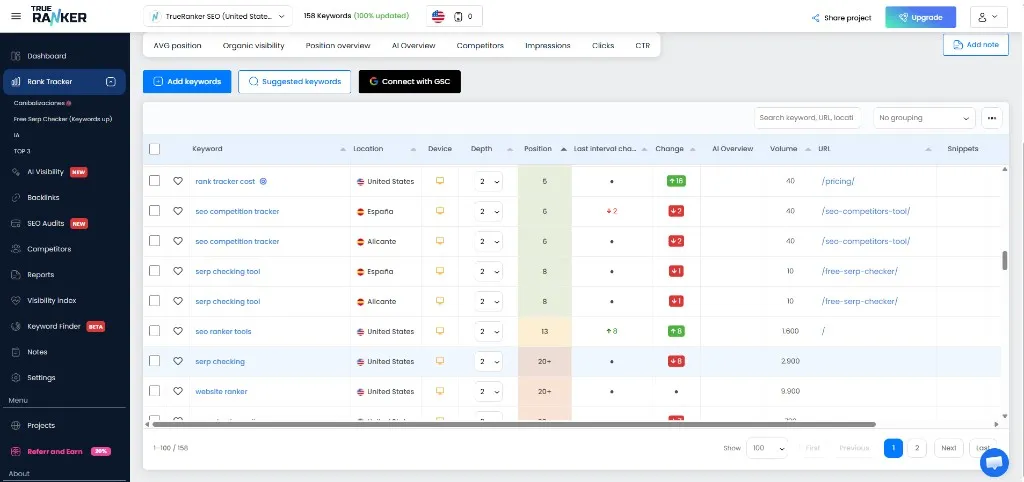
If you still want a daily position, keep it in a rank tracker and read a move that only shows up on page 2 as a data problem. The collection isn’t clean.
Don’t mix our 30% with their 8%.
A one-day drop is usually a poisoned SERP, not a ranking change
Most spells are a single fetch. Nozzle found that 80% last one SERP, 15% last two, and 5% last three or more. The next SERP has the usual sites back 55.9% of the time. 77.9% are back within three days. The median is two days. That’s poisoned SERPs since September 13 that got a follow-up fetch inside the window.
Comparing against yesterday alone is fragile, because yesterday may have been poisoned too. I compare against the keyword’s usual page-1 sites over the previous weeks. A real ranking change stays. This one usually doesn’t.
Search Console is the other observation. If the site disappears in the tracker and Console still shows impressions and clicks, nothing happened to the site. A mismatch between the tracker and your own browser is a different bug: location, device or login. I wrote that up in why a rank tracker doesn’t match the Google you see. Here the stored page itself is the wrong page.
The September spam update ran through the same weeks. Google’s ranking update history puts it at 13 days and 16 hours, from September 24 through October 8. A drop on September 29 can be the update, a poisoned SERP, or both. Search Console was behind that same week: on October 11 the Performance report was more than 64 hours behind, and it was current again by the morning of October 12.
Before I send a report I check four things:
- Whether the keyword’s usual sites over the last few weeks are actually gone, not just gone since yesterday
- Whether Search Console still has clicks and impressions for those URLs
- Whether the drop came back within three days
- Whether only page 2 moved
Search Console clicks mean the site didn’t vanish
Impressions and clicks in Search Console are Google’s count of real searches. A poisoned SERP is a page served to a scraper. If Console kept the clicks, the rankings didn’t vanish. If Console dropped with the tracker and the drop is still there a week later, I treat it as a ranking change. The spam update is the other candidate for a drop that stays.
A drop that stays is different.
Frequently asked questions
Is Google doing this to rank trackers on purpose?
Google hasn’t said so. Schwartz’s read is that the blocking, the captchas and the bad data are aimed at AI bots and at SerpApi, and rank trackers get hit because they collect SERPs the same way. I can confirm the effect on our fetches. I can’t confirm the motive.
The effect is measured. The motive isn’t.
How long does a poisoned SERP last?
Usually one fetch. Nozzle found that 80% of spells last a single SERP, and 77.9% of poisoned SERPs have their usual sites back within three days. The median is two days. That share is poisoned SERPs since September 13 that got another fetch of the same keyword inside three days.
Most poisoned SERPs are gone within three days.
Does the bad data start on page 1 or on page 2?
Both show up, and they aren’t the same number. Nozzle’s poisoned SERPs lose usual sites across the whole result, including page 1. The “white label local seo” example lost 9 of 9 page-1 sites between October 4 and October 7. On this collection, as of October 13, the mismatch that’s still showing up starts on page 2, on about 30% of SERPs. Page 1 can look normal while page 2 doesn’t answer the query.
Page 2 is our measurement, not theirs.
Should I trust a one-day drop in late September?
Not by itself. September 27 to 29 were the worst days in Nozzle’s chart, around a quarter of SERPs. A one-day drop then, with the usual sites back inside three days, is more likely a poisoned page than a ranking change. A drop that is still there, and that Search Console agrees with, can be the spam update that ran from September 24 to October 8.
One late-September day isn’t a verdict.
Are the trackers fixed now?
No. There were a few quieter days. As of October 13 the bad results are back from page 2, on about 30% of the SERPs in this collection. That isn’t a full fix. SE Ranking said on October 12 that Google rankings were “missing positions for some keywords” and that most of that issue had been resolved. The same week’s reports still had Ahrefs, Semrush and SISTRIX disagreeing on a September 29 drop. A tracker can look settled and still store poisoned pages.
A few quiet days wasn’t a fix.
Read the chart before you tell a client the site crashed
A one-day drop that comes back is a data problem. A drop that stays, and that Search Console agrees with, is the one to act on.
Written by

Sergio Pérez
Co-Founder, Lead Backend & Infrastructure
Sergio co-founded TrueRanker and owns the backend those rankings run on: servers, security, uptime, and the data logic behind rank tracking, backlink monitoring and AI-visibility checks. He writes about technical SEO — 404s, content clusters, crawl health — because that is the layer he builds, not a topic he borrowed. If a position, a link or a citation is late or wrong, it is his stack that has to answer.
You might be interested
How to Detect and Fix SEO Cannibalization (Real Case Study) [2026]
Are your pages competing on Google? Learn how to spot SEO cannibalization, set Target URLs, and reclaim your traffic with TrueRanker.
Javier Quevedo5 min read
Read the postHow to Deindex a Page from Google (Fast & Permanently) [2026]
Three ways to deindex a URL from Google: a temporary Search Console removal, a permanent noindex tag, or a 410 / login wall when it must never return.
Javier Quevedo3 min read
Read the postHow to detect and fix 404 errors
A 404 error kills your rankings. Learn how to check for 404 errors using free tools, fix broken links, and recover your lost SEO traffic.
Sergio Pérez4 min read
Read the post