Rank Tracker Not Matching Google? Why Both Numbers Are Real
Rank tracker not matching Google? See the six variables that split the two numbers, why incognito doesn't fix it, and how to check your real position.

A rank tracker and a live Google search don’t measure the same SERP. The tracker queries Google from a fixed location, on a fixed device, with no history, at a recorded time. Your browser shows the page Google built for you, there, now.
A rank tracker not matching Google is the default, not the bug. Both numbers are real. They answer different questions.
Depends how you measure it.
Before I argue about who’s right, I write down the six variables: location, device, login, timestamp, what counts as a position, which URL the project is watching. Skip one and you are comparing apples to oranges.
Name those six before you report.
The two numbers split on six conditions
Your browser and the tracker disagree because they don’t share location, device, login, timing, counting rules or URL scope. Hold those six still and the gap usually shrinks. Leave them mixed and the report is no longer one SERP.
| Variable | Your browser | The tracker | How to match them |
|---|---|---|---|
| Location | The IP or GPS Google infers | The country, city, zip or coordinates you set | Search from that same point, or change the tracked location |
| Device | The phone or laptop you have open | Desktop or mobile, set per keyword | Compare mobile to mobile, desktop to desktop |
| Login and history | Signed-in profile, past searches, clicks | No account, no cookies | Log out. Incognito only strips this row |
| Timing | Right now | The last scheduled fetch | Read the fetch timestamp before you compare |
| How the rank is counted | Everything you can see on the page | Organic listings; the local pack stored separately | Don’t treat a pack or an AI Overview as the organic rank |
| Which URL | The URL you happened to spot | The project scope (domain, folder, one URL) | Check the ranking URL, not just the brand name |
A mixed row is not a ranking.
I opened the TrueRanker USA project and read the row before I typed anything into Google. Keyword: rank tracker alternative. Location: United States. Organic position: 1, with the crown. Search Console on the same row said 3.5, off 4,039 impressions.
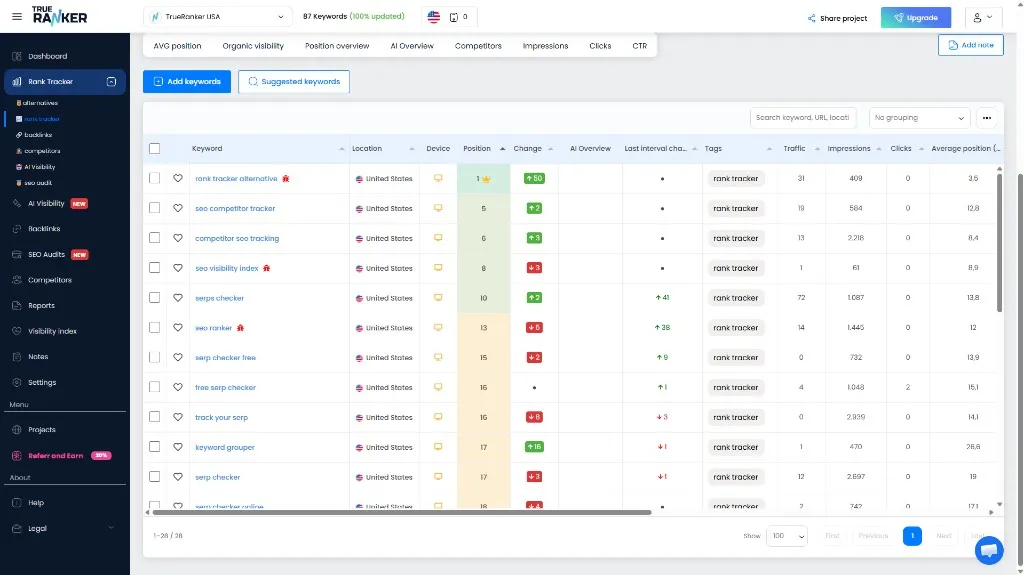
I searched the same term from Spain, on my laptop, signed in. I didn’t see us at 1. I was looking at a Spanish IP, an account that visits this site every day, and a different clock than the last fetch.
Location first. The crown is a United States reading. The 3.5 is every impression Google blended. My tab was a third SERP.
Six variables that split the two numbers
The mismatch almost always sits in one of six places. Location and device do most of the work. Timing and counting rules do the rest. I check them in this order, because the first two close most of these mismatches.
Fix the omitted variable first.
Location: Google reads your IP, the tracker reads a fixed point
Google localizes the results from your IP, and from a tighter point if you shared GPS. The tracker reads the country, city, zip or coordinates you typed when you added the keyword. Those aren’t the same point unless you made them the same point.
Search “plumber” from your office and the map pack is the street outside. Track “plumber” as United States and Google has to invent a country-wide page that no customer in Denver actually sees. City first, country only when the business is really national — I walked through that split in local SEO tracking.
Scroll to the footer of the results. The location Google used is printed there. On the stored SERP behind a rank-tracker alternative query it reads United States, from the IP. Compare that line to the location column in the tracker. Different zip codes in the same city already move the pack.
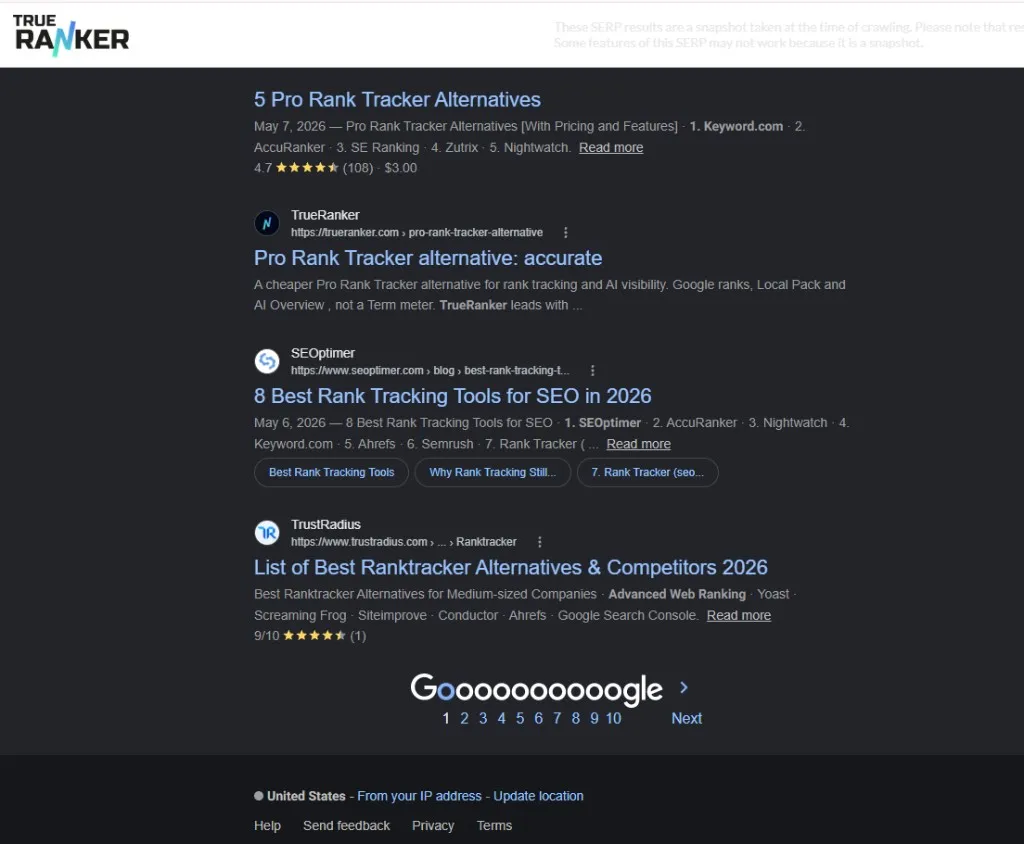
Same point on the map, or don’t compare.
Device: mobile and desktop are two different SERPs
Mobile vs desktop rankings are two indexes, two layouts, two local weights. Google predominantly ranks the mobile version of the page. A desktop check on a local service keyword is the screen most of those searchers are not using.
In TrueRanker a keyword is the term plus the location plus the device. I don’t average the two screens into one cell. If the project is set to mobile and you open desktop, the numbers will diverge and each one will still match its own screen.
Same device, or the row is noise.
Login and history: Google personalizes the results for you
Google personalized search results follow the signed-in account: past queries, clicked links, language, region. You visit your own site every day, so Google has every reason to surface it for you faster than for a stranger. You are a biased sample of your own brand.
The tracker has no Google account and no cookie jar. That’s the point of a controlled fetch. It’s also why your logged-in tab will look kinder than the report.
A signed-in check is a check of you, not of the market.
Timing: the tracker read the SERP hours or days before you did
SERP volatility isn’t a slogan. Listings outside the first few results move between fetches. Google recrawls, tests a layout, puts a result back. The tracker stored the page at the last scheduled run. You opened Google at 4:40 p.m.
In TrueRanker the schedule is per project: TOP 20 daily, TOP 50 every three days, or TOP 100 weekly. A weekly TOP 100 row compared to a search you just ran can be six days stale. That’s not a tracker error. It’s the window you picked.
Hover the updated timestamp before you screenshot the disagreement. If you can’t say when the figure was collected, it doesn’t go in the report.
Read the timestamp, then the rank.
Organic rank and local-pack rank are two numbers
The organic rank and the local-pack rank are two numbers. TrueRanker counts the organic listings. Featured snippets, AI Overviews, People Also Ask, ads, image packs and video carousels are flagged on the keyword. They don’t take a slot in that organic number.
The local pack is the exception. The tracker stores your place in the pack, and your competitors’ places, as their own reading. On a polyclinic project in El Campello, sexología en El Campello sits at organic 1 and local-pack 3 on the same row. Two numbers. Your browser shows one page. The tracker shows two columns.
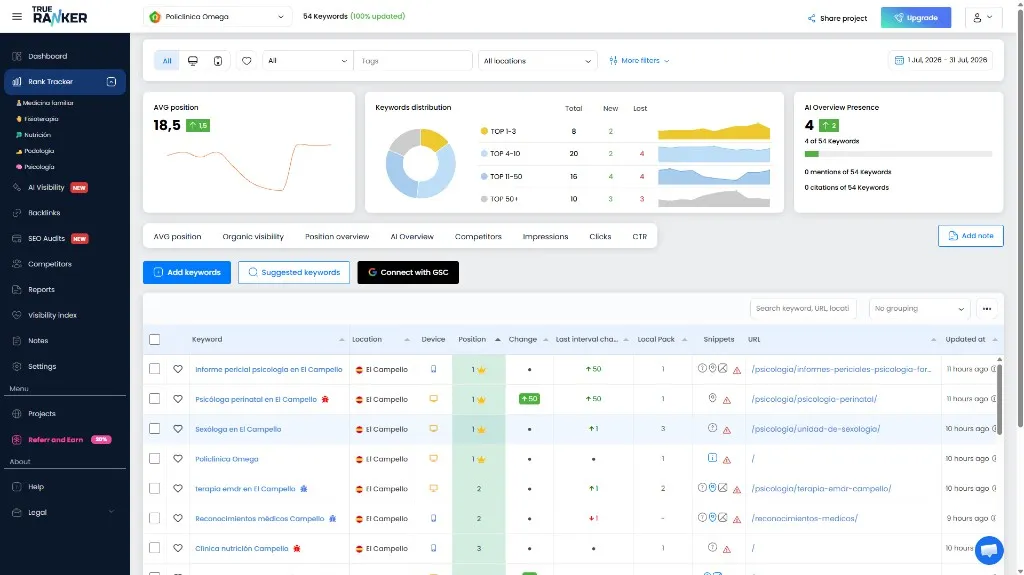
If you counted the pack as position 1 and the tracker counted the first organic result as position 1, you didn’t find a bug. You found two rulers.
Organic and the pack are two readings.
Which URL is ranking: another page on your domain took the spot
The tracker reports the URL that matches the project type: one domain, domain plus subdomains, a folder, or a single URL. Your eye reports whichever result you recognized.
If blog.example.com/guide ranks and the project is scoped to www.example.com with no subdomains, the tracker won’t credit that hit. If two URLs on the same host rank for the same query, you may be looking at SEO cannibalization rather than a missing rank.
Open the ranking URL in the table. If it isn’t the page you had in your head, the brand is ranking and the page you wanted isn’t ranking.
Credit the URL the project is watching.
Why checking Google in incognito doesn’t fix it
Incognito (or a private window) drops the login and the cookies. It doesn’t give you a non-personalized ranking. You still search from your IP, on your device, in your region, at this minute. Location, device and timing stay in the query.
That’s why checking Google rankings in incognito feels cleaner and still disagrees with the tracker. You removed one row from the table. Five are left.
What incognito removes:
- The signed-in Google account
- Cookies and most on-device search history
What incognito keeps:
- Your IP, and the city Google pins to it
- Desktop vs mobile
- Language and region settings on the browser
- The SERP features that load that second
- The fact that you’re not the scheduled fetch from last night
Treat the private window as a spot-check. It isn’t a measurement system.
Incognito is cleaner. It isn’t neutral.
Why the gap got wider after September 2025
Google has always made automated SERP collection harder than a person typing a query. Since September 2025 that pressure is higher. I see it in the pages the collector brings back every day: more thin or inconsistent SERPs, more retries before a position is stored, more cases where a clean query and a logged-in browser land on different layouts.
I don’t have a rate I can publish. A rough number is not a number. The direction is enough to change how I read a one-day gap.
| What the collector brings back | What it is not | What I do before I report it |
|---|---|---|
| A thin or featureless SERP | A ranking loss | Retry the fetch; don’t store the first page if it looks incomplete |
| A country-wide page that doesn’t match a city check | A broken keyword | Read the footer location; move the row to the city the customer is in |
Result links wrapped in goto URLs |
A different ranking URL | Resolve the destination after the fetch, not with a burst of extra requests |
A second, documented change sits on top of that. In August 2026 Google started wrapping result links in goto tracking URLs. A naive collector that follows every redirect from the same address behaves like no human session. That’s one more reason a tool SERP and a person SERP can diverge even when location and device match.
None of this makes the tracker “wrong” and the browser “right”. It makes the object being measured several SERPs: by place, by person, by how the query was sent. I report a controlled page under named conditions. I don’t pretend that page is every page.
A controlled SERP is still one SERP.
Search Console average position vs rank tracker: two different numbers
Search Console average position is the mean of the topmost slot your site held across the impressions in the date range. It blends locations, devices, signed-in and signed-out sessions, and it treats an AI Overview citation under the same rules as an organic listing. Google documents that blend in the Search Console performance report.
A rank tracker is a position at one moment, from one location, on one device, for one keyword. That’s why average position vs rank tracker won’t match. One is a mean over a window. The other is one snapshot.
Use Search Console to ask whether real impressions and clicks moved in the same direction as the tracked line. Don’t use it to settle Tuesday’s number. Connecting GSC to the project puts those clicks next to the exact rank each keyword holds, which is the honest join: two instruments, one table.
A monthly average isn’t Tuesday’s rank.
A real Google position is one you can repeat
There is no single true rank. A defensible rank is one you can repeat: stated location, stated device, stated language, same method next week. That’s how you check your real Google position. Anything else is a screenshot of you.
- Write the keyword, the city (or zip), and the device you actually care about.
- In the tracker, confirm those three match the row. Read the last-fetch time.
- Open the stored SERP behind that position if the tool keeps one. Check that your URL sits at the recorded organic slot, and whether a local pack or an AI Overview is also on the page.
- For a manual spot-check, log out, use a private window, and set the location to that same city. Don’t treat that tab as the verdict.
- Cross-read Search Console for the same query and device over the last 28 days. You want direction, not a matching integer.
- If the project is on TOP 20 and you can see the URL on page 3, you are outside the window the collector was set to watch.
A one-off free SERP check from a chosen country is the honest manual version of step 4: no account history, a location you pick, a result you can discard. Daily history, city or coordinates, desktop and mobile as separate rows — that’s the rank tracker.
Same conditions, or a different page.
Frequently asked questions
Why are my Google rankings different when I search my own site?
Because Google personalizes results for you. You are signed in, you search from your usual city and device, and you visit your own pages constantly. Those signals make Google surface your site more readily for you than for a stranger. The tracker has none of that context, so it will look colder. The colder number is closer to a new visitor.
Does incognito show my true Google ranking?
No. A private window drops the account and the cookies. Your IP, device and region still shape the page. Incognito is a cleaner spot-check than a logged-in tab. It isn’t a non-personalized ranking, and it isn’t the scheduled fetch in the report.
Why is my mobile ranking different from desktop?
Google builds two result pages. Layouts differ, the local pack weighs more on phones, and the index prefers the mobile version of your URL. If most of the traffic is mobile, judge the mobile row. A desktop win on a phone query doesn’t mean the ranking improved.
How often should I compare my tracker with Google?
Often enough to see a trend, not so often that a Tuesday wobble becomes a rewrite. I re-check a disputed keyword after the next scheduled fetch, with the same location and device. Daily noise is ranking fluctuations. A move that holds across two or three fetches is a finding.
Why does my tracker say 20+ when I see my site on page 2?
The project is probably on TOP 20 daily. Position 21 and below are outside that window, so the cell reads 20+ even if a live search on page 2 shows you. Switch that project to TOP 50 or TOP 100 if page 2 is the band you need to see, and wait for the next cycle. Seeing the URL in your own browser doesn’t enlarge the fetch you configured.
Track every keyword from a fixed location and device
Same point on the map, same screen, a check with a date on it. That's the reading you can put next to last week's.
Written by

Sergio Pérez
Co-Founder, Lead Backend & Infrastructure
Sergio co-founded TrueRanker and owns the backend those rankings run on: servers, security, uptime, and the data logic behind rank tracking, backlink monitoring and AI-visibility checks. He writes about technical SEO — 404s, content clusters, crawl health — because that is the layer he builds, not a topic he borrowed. If a position, a link or a citation is late or wrong, it is his stack that has to answer.
You might be interested
How to write SEO reports for clients they'll actually read
What belongs in SEO reports for clients, which metrics earn a place, and how to write one, with a real sample of rankings, links and AI visibility.
Javier Quevedo8 min read
Read the postAutomated SEO Reporting: Stop Wasting Non-Billable Hours [2026]
Stop wasting non-billable hours. Create automated, white-label SEO reports with custom charts and Google Search Console data using TrueRanker.
Javier Quevedo3 min read
Read the postDiscover the position in Google of your website’s keywords
Check real Google rankings without Incognito guessing: daily tracking and the SERP your customers actually see.
Javier Quevedo4 min read
Read the post