7 Best Otterly AI Alternatives for Tracking AI and Search in 2027
Looking for Otterly AI alternatives? We compared 7 AI search trackers on pricing, citation accuracy, engine coverage, and real Google search integration.

You have probably already run into this situation. You set up prompt monitoring to see if ChatGPT or Perplexity mentions your brand, and suddenly you are looking at an invoice for $189 a month just to check a hundred questions on a single platform.
That is where most teams hit the wall with Otterly.ai. It was among the first tools to give marketers a clean dashboard for generative search monitoring, and for simple brand audits, it works. But once you run real client campaigns or manage organic growth across multiple search channels, isolated prompt observation starts showing its limits.
In my experience growing organic search platforms, treating AI engines as a completely disconnected world from Google is an expensive mistake. You shouldn’t need three separate subscriptions to see why an answer in ChatGPT shifted after your organic rankings moved in Google.
Below is an honest breakdown of the seven best Otterly AI alternatives in 2027, comparing engine coverage, citation data accuracy, real workflow capabilities, and total software cost.
Quick comparison: The best Otterly AI alternatives at a glance
The best Otterly AI alternative depends on whether you need a dedicated enterprise engine tracker, a budget prompt counter, or a platform that ties AI visibility directly to your daily Google rankings.
Here is how the top options compare across core features, coverage, and pricing models:
| Tool | Best for | AI Engines Covered | Google Rank Tracking Included? | Starting Price | Free Trial |
|---|---|---|---|---|---|
| TrueRanker | Unified AI visibility + daily Google SEO | ChatGPT, Claude, Gemini, Perplexity, DeepSeek, Grok, AI Overviews | Yes (Daily, geolocated by city) | Affordable multi-engine plans | 14 days (No credit card) |
| Peec AI | Simple prompt monitoring for agencies | ChatGPT, Perplexity, Claude, Gemini | No (AI search only) | €89/mo | Paid trial / Demo |
| Profound | Enterprise brands & custom agent workflows | ChatGPT, Perplexity, Gemini, Claude, Copilot | No (AI search only) | ~$499–$1,000+/mo | Demo only |
| Semrush AI Toolkit | Teams already running their full SEO on Semrush | ChatGPT, Perplexity, Google AI Overviews | Yes (Within main Semrush suite) | $99/mo add-on + Semrush plan | Part of Semrush trial |
| AthenaHQ | Multi-model testing with credit-based pricing | ChatGPT, Claude, Perplexity, Gemini, Mistral | No (AI search only) | Usage/credit tiers (~$100+/mo) | Limited test tier |
| Scrunch AI | Technical crawler audits & bot log analysis | ChatGPT, Perplexity, Claude, Gemini | No (Crawler focus) | Custom / Mid-market (~$250+/mo) | Demo only |
| Rankscale | Scheduled prompt execution and cadence control | ChatGPT, Perplexity, Claude | No (AI search only) | ~$79–$150/mo | Limited demo |
If you want to see where your brand stands right now without committing to a dedicated tool stack, you can run a quick check with our free AI visibility checker to see how major models respond to your core prompts.
Where Otterly.ai falls short (and why teams look for alternatives)
Teams look for Otterly AI alternatives primarily due to steep pricing per tracked prompt, the lack of traditional Google SERP integration, and a reporting system that struggles to separate unlinked brand name-drops from verifiable citations.
Otterly.ai dashboard displaying high-level brand mention percentages and prompt observation feeds.
When evaluating Otterly.ai against real production workflows, three distinct friction points emerge:
1. The hidden cost of isolated prompt tracking
Otterly.ai operates strictly in the generative search silo. If you want to track 100 prompts across multiple engines with regular updates, you are pushed into tiers starting around $189 per month.
For that investment, you receive zero data on your Google positions, zero local search ranking tracking, and zero backlink intelligence. That means you still have to pay your standard SEO tool subscription on top. Paying two premium software bills just to track organic visibility across search bars and chat boxes does not make financial sense for most agencies.
2. Brand mentions versus clickable citations
In AI search optimization (AEO / GEO), a mention and a citation are completely different outcomes:
- A brand mention means the LLM wrote your company name in its text response. It builds awareness, but it provides no direct referral pathway.
- A citation means the model included your exact URL as a clickable source badge or linked footnote. That is what drives qualified referral sessions to your landing pages.
Otterly often lumps these together under general “visibility” scores. If a platform cannot show you the exact cited domain and the underlying source that fed the model’s response, you cannot reverse-engineer why your competitors are getting recommended instead of you.
3. Limited engine diversity beyond US-centric baselines
While Otterly covers core engines like ChatGPT and Perplexity, modern generative discovery moves across models like DeepSeek, Grok, Claude 3.7, and Google’s evolving AI Overviews. Tracking only a standard ChatGPT snapshot leaves blind spots across international audiences and specialized enterprise buyers.
7 Best Otterly AI Alternatives reviewed
1. TrueRanker: Best overall alternative for unified AI visibility and Google rank tracking
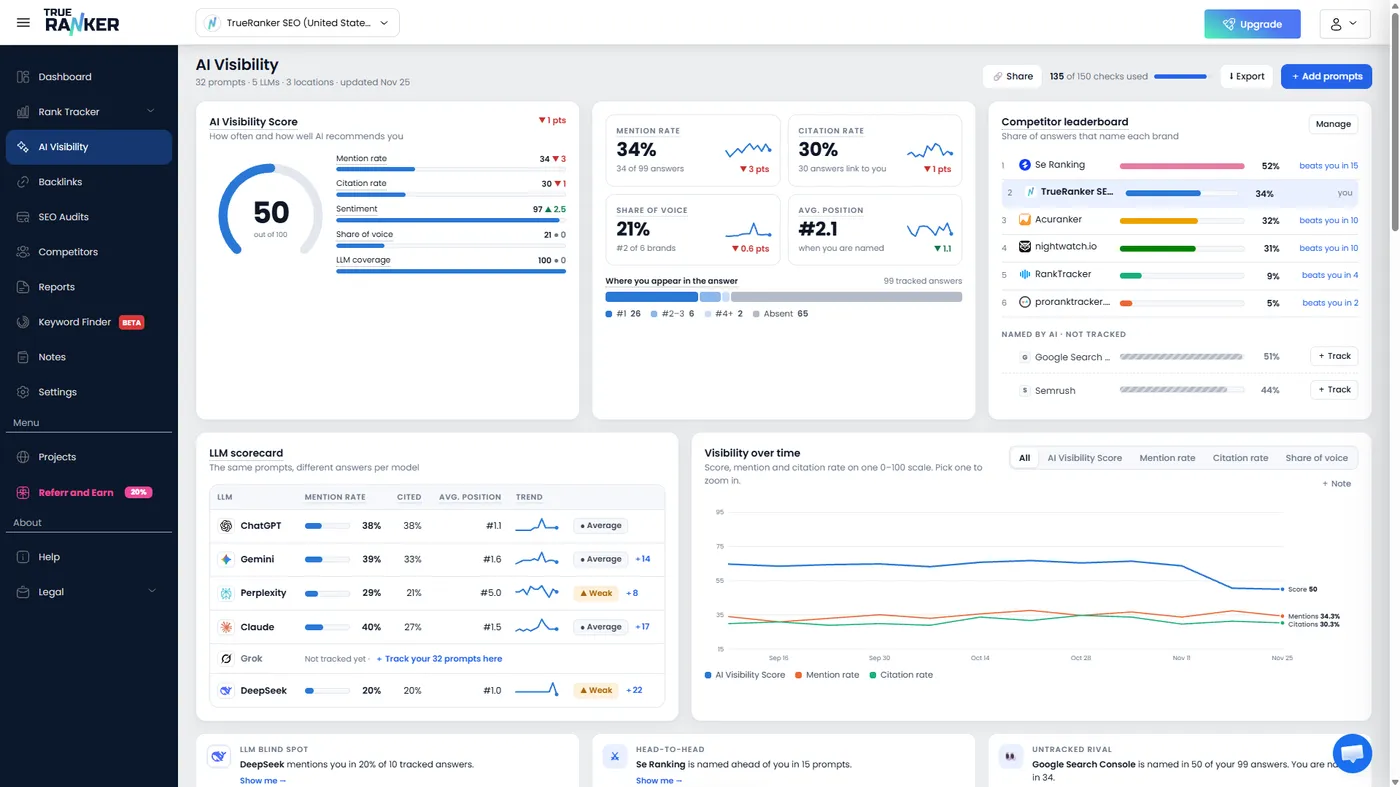
TrueRanker is the best overall Otterly AI alternative because it brings AI visibility tracking and daily, geolocated Google SERP monitoring into one unified, cost-effective platform.
TrueRanker AI Visibility dashboard displaying mention frequency, citation rates, and share of voice across generative engines.
Instead of forcing you into a standalone prompt tracker, TrueRanker integrates its AI Visibility module directly alongside your keyword rank tracking, backlink monitoring, and technical URL audits. You can inspect your performance across ChatGPT, Claude, Gemini, Perplexity, DeepSeek, Grok, and Google AI Overviews while tracking your traditional rankings down to the city and zip-code level.
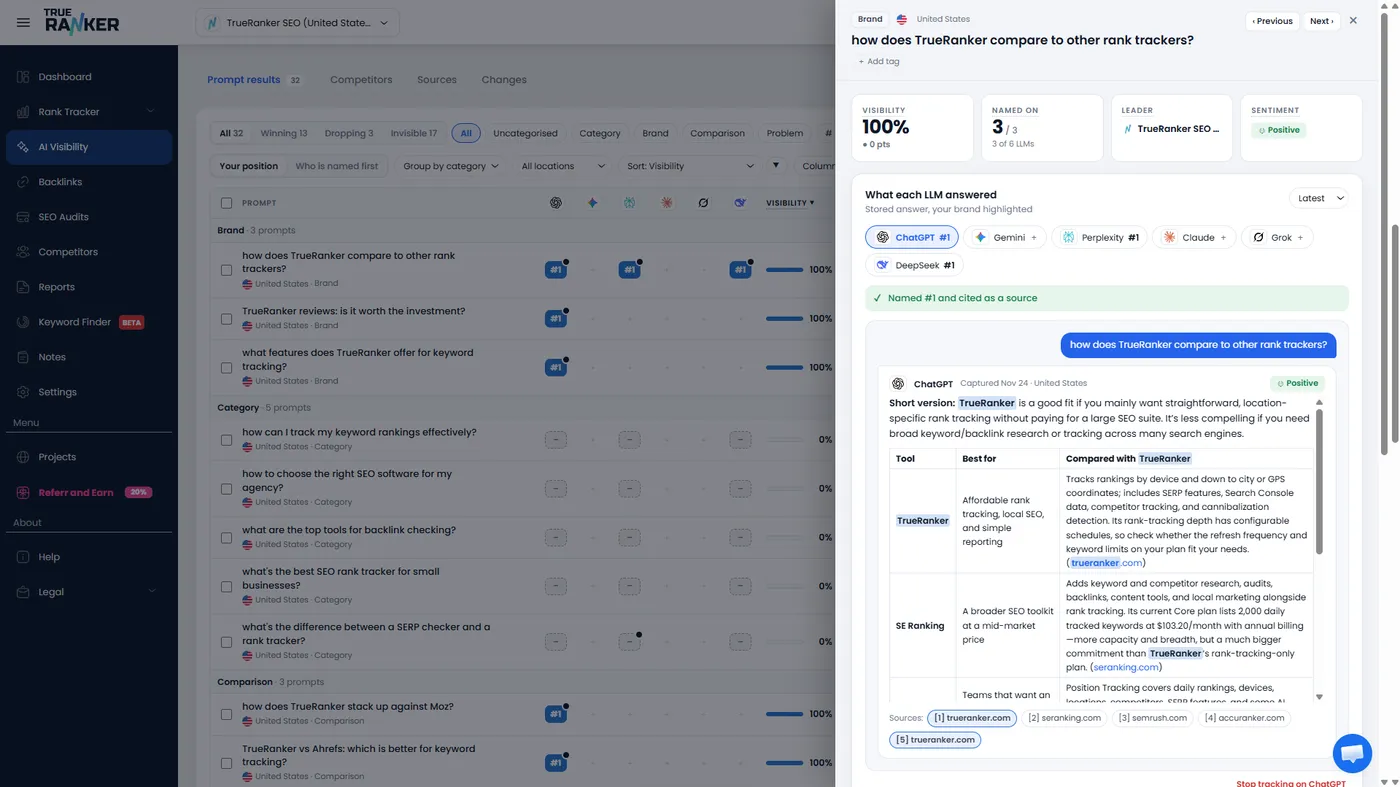
One of the standout features is the literal response auditor:
Literal response inspection in TrueRanker showing whether an engine generated an unlinked name-drop or a clickable citation URL.
You can open the exact response generated by the model, verify whether your domain was cited as a primary source, and identify which third-party directories or competitor pages the AI referenced to build its answer.
Why choose TrueRanker over Otterly.ai?
- Unified SEO stack: Monitor LLM prompts and Google keywords on mobile and desktop without switching tools.
- Granular citation tracking: Clearly separates unlinked brand mentions from clickable source links.
- 7 major AI engines: Track ChatGPT, Gemini, Perplexity, Claude, DeepSeek, Grok, and Google AI Overviews in one place.
- Competitor Share of Voice: Compare how frequently your brand appears against direct rivals on identical buying prompts.
- No budget bloat: Access complete AI search tracking without paying enterprise premiums. Check our transparent tiers on the TrueRanker pricing page.
Where it falls short:
- TrueRanker is built for organic search teams and agencies; it does not offer automated AI content generation or auto-publishing features.
Verdict: If you are tired of paying $189+/mo for a tool that only checks prompts, TrueRanker gives you deep multi-engine citation data plus complete Google rank tracking at a fraction of the total software cost. You can learn more about how we compare directly on our Otterly.ai comparison page or explore the full AI visibility tracker.
2. Peec AI: Best budget-friendly tracker for clean prompt dashboards
Peec AI is a focused AI search tracker designed for agencies and marketing teams that want an uncluttered interface and unlimited user seats.
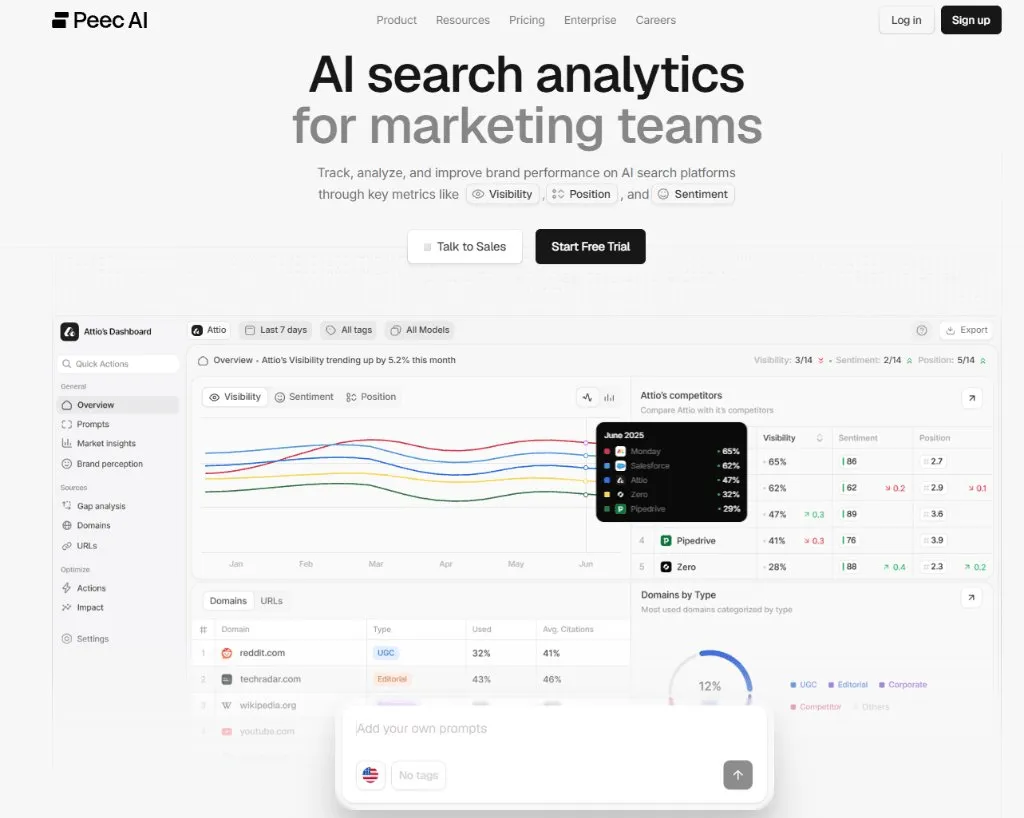
Peec AI interface providing prompt monitoring cards and sentiment overviews.
Peec AI strips away complex enterprise configurations in favor of a straightforward dashboard. It monitors ChatGPT, Perplexity, Claude, and Gemini, providing sentiment analysis, basic citation sources, and competitor presence indicators.
Key features:
- Clean, intuitive dashboard that requires virtually zero onboarding time.
- Unlimited team members on standard agency plans.
- Sentiment classification (positive, neutral, negative) for brand answers.
Where it falls short:
- Like Otterly, it is strictly an AI prompt tracker. You will still need a separate rank tracker for your Google search campaigns.
- Starting at €89/mo, it remains an added software cost if your team already manages standard SEO tool subscriptions.
Verdict: Peec AI is a solid alternative if you only want prompt monitoring with a smoother interface than Otterly and need to share dashboards across multiple team members without per-seat fees.
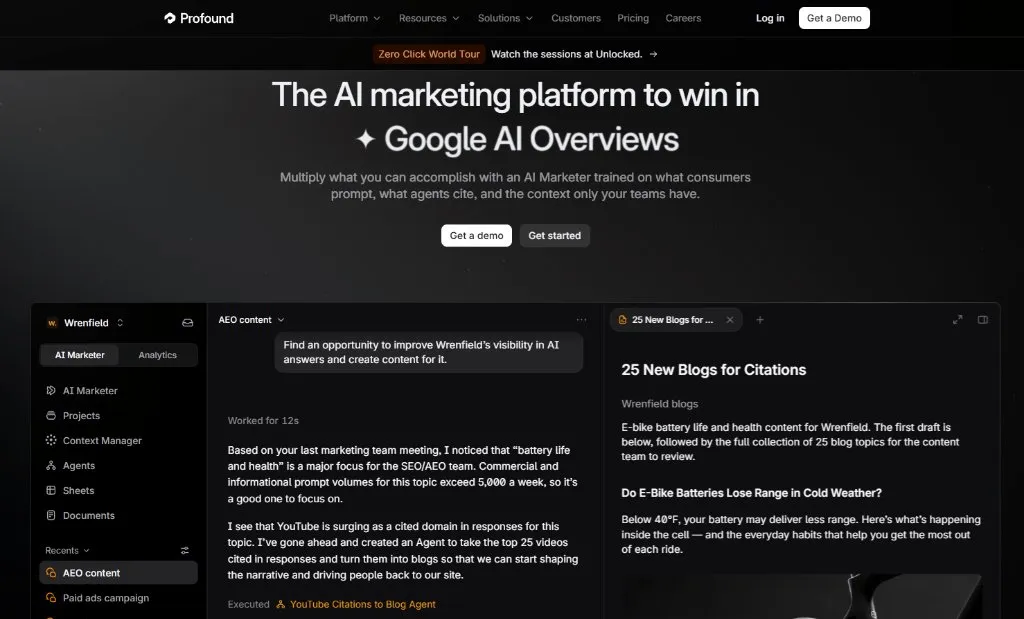
3. Profound: Best for enterprise brands with bespoke agent workflows
Profound is a high-end enterprise AI visibility platform built for Fortune 500 companies and large digital teams with significant analytics budgets.
Profound platform overview showing market share metrics and prompt volume analytics.
Profound approaches AI search tracking from a data engineering angle. It offers deep prompt clustering, extensive agent simulation, and API access designed to feed internal corporate business intelligence platforms.
Key features:
- Broad coverage across consumer engines and enterprise copilot environments.
- Deep prompt variation mapping and semantic clustering at enterprise scale.
- Robust data export and API integrations for custom internal reporting.
Where it falls short:
- Cost: Pricing regularly starts between $499 and $1,000+ per month, placing it well out of reach for small businesses and boutique agencies.
- Complexity: The platform requires dedicated onboarding and setup to extract actionable value.
- No integrated Google rank tracking or classic SEO toolkit.
Verdict: If you manage a global consumer brand with a five-figure monthly software budget, Profound delivers enterprise-grade depth that surpasses Otterly. For everyone else, it is substantial overkill.
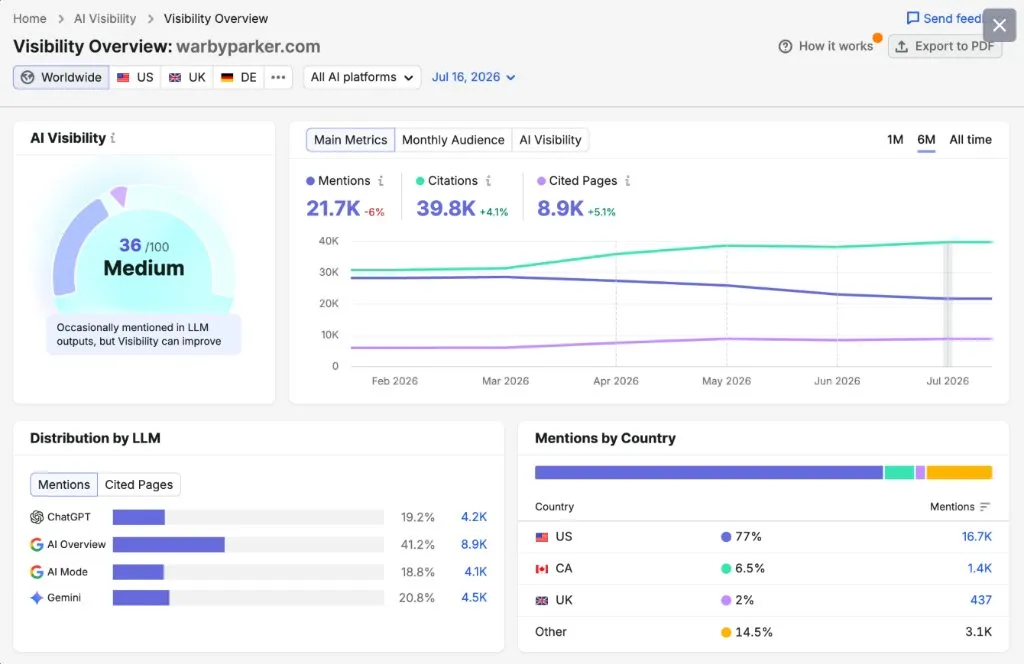
4. Semrush AI Visibility Toolkit: Best if your workflow already lives in Semrush
The Semrush AI Visibility Toolkit is an add-on module for existing Semrush subscribers who prefer keeping all their search metrics under one vendor roof.
Semrush AI Visibility Toolkit dashboard displaying visibility index scores, citation metrics, and distribution across ChatGPT, Gemini, and Google AI Overviews.
If your agency already runs daily client reporting through Semrush, this add-on tracks your brand’s presence in ChatGPT, Perplexity, and Google AI Overviews directly within your familiar workspace.
Key features:
- Seamless integration with existing Semrush projects and keyword lists.
- Combined reporting capabilities alongside Semrush Position Tracking.
- Identification of domain citations within generative search answers.
Where it falls short:
- Add-on cost: It costs an additional $99/mo on top of an already pricey base Semrush subscription (Pro plans start at $139.95/mo).
- Strict prompt limits: The basic add-on tier only includes 20 tracked prompts, charging steep fees for additional query volume.
Verdict: Convenient if you already spend thousands annually on Semrush and want basic AI tracking in your client decks, but very restrictive on prompt volume compared to dedicated trackers.
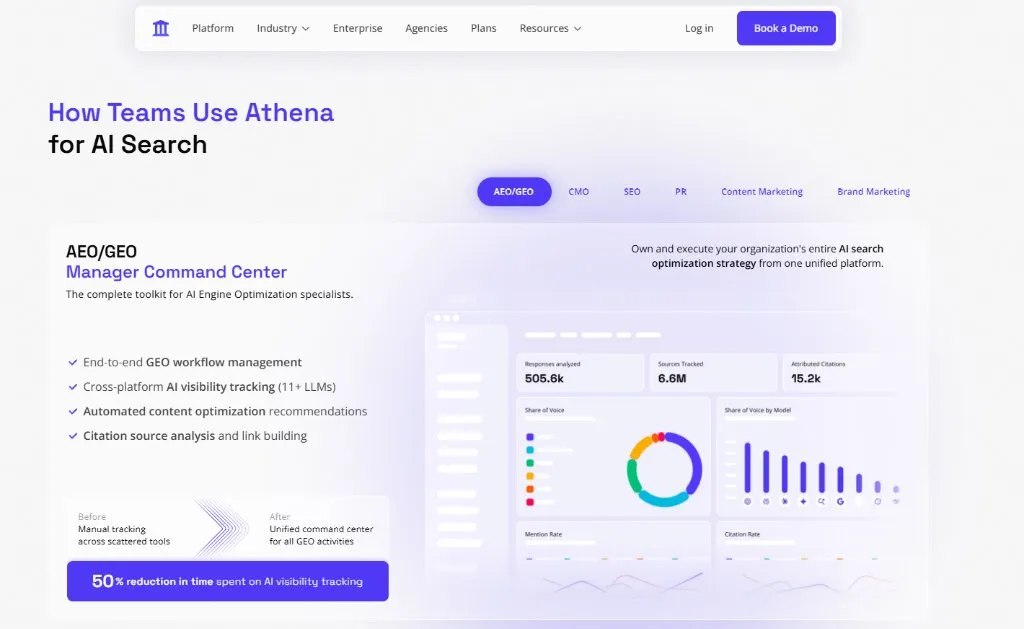
5. AthenaHQ: Best for multi-engine coverage on a credit-based model
AthenaHQ is an AI search monitoring tool that provides extensive engine coverage using a flexible, credit-based usage structure.
AthenaHQ platform overview displaying response analyses, tracked citation sources, and model-by-model share of voice.
AthenaHQ monitors brand appearances across a broad array of models including ChatGPT, Claude, Perplexity, Gemini, and open-source models like Mistral. It also provides actionable recommendations on how to adjust your content to influence model responses.
Key features:
- Wide multi-model support beyond standard consumer chatbots.
- Optimization suggestions based on third-party sources cited by the models.
- Flexible prompt execution cadences.
Where it falls short:
- Credit-based consumption can make monthly billing unpredictable during heavy testing periods.
- Does not monitor Google organic SERP rankings or keyword positions.
Verdict: A versatile option if you like testing niche models or want content adjustment guidance, though credit tracking requires careful oversight.
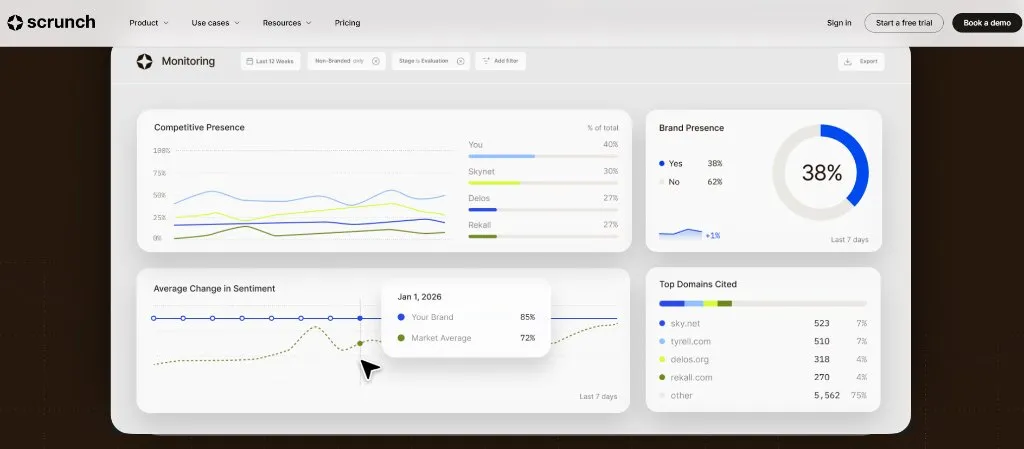
6. Scrunch AI: Best for technical crawler diagnostics and bot traffic
Scrunch AI takes a technical, infrastructure-first approach to generative search by analyzing how AI crawlers interact with your website.
Scrunch AI monitoring dashboard showing competitive presence curves, brand mention rates, and top cited external domains.
Rather than focusing solely on output answers, Scrunch helps technical SEOs analyze server logs, detect visits from GPTBot, ClaudeBot, and PerplexityBot, and audit whether your site’s JavaScript or paywalls are blocking AI scrapers.
Key features:
- Server log tracking for generative AI crawler user-agents.
- Technical audits evaluating how easily LLMs can parse and ingest your content.
- Buyer journey touchpoint mapping in AI search engines.
Where it falls short:
- Geared toward technical diagnostics rather than simple marketing rank reporting.
- High barrier to entry and mid-market enterprise pricing (~$250+/mo).
- Does not replace standard keyword rank tracking.
Verdict: Excellent for technical SEO teams troubleshooting crawlability issues with AI agents, but less practical for standard monthly agency reporting.
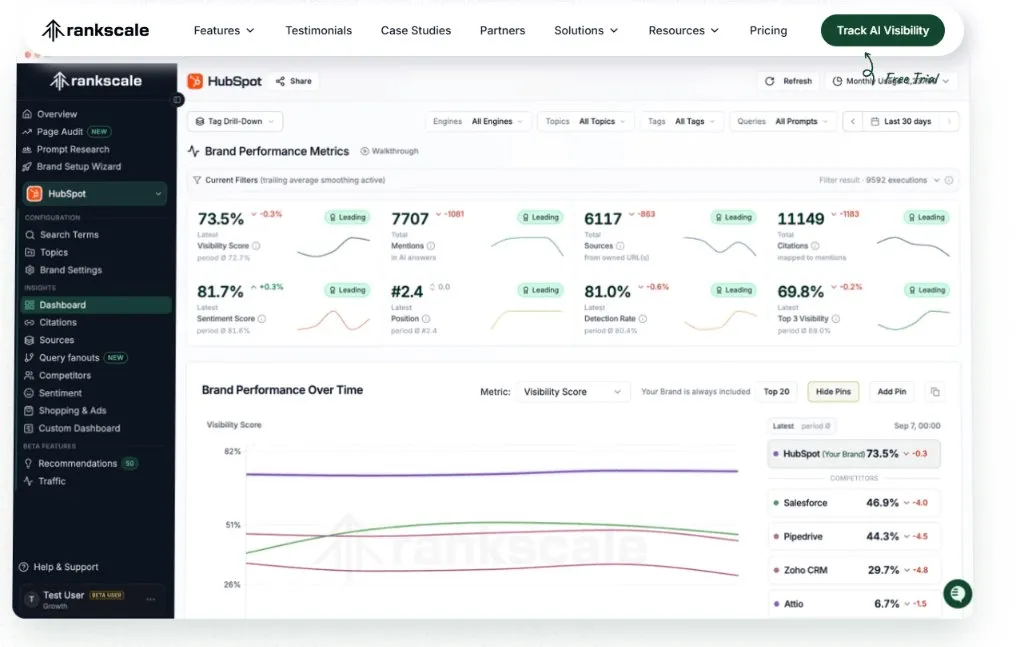
7. Rankscale: Best for cadence control and scheduled prompt runs
Rankscale is an AI search tracking tool focused on giving users granular control over when and how often prompts are evaluated.
Rankscale dashboard highlighting prompt execution cadences and brand visibility metrics.
A common complaint with Otterly is paying for daily runs on prompts that rarely shift. Rankscale lets you adjust execution frequency (weekly, bi-weekly, or daily), allowing marketing teams to stretch their monitoring budget across a larger keyword pool.
Key features:
- Custom execution scheduling to optimize prompt budgets.
- Tracking across ChatGPT, Perplexity, and Claude.
- Clean citation source discovery tables.
Where it falls short:
- Tracking is limited to generative search engines only.
- Smaller feature set compared to comprehensive SEO suites.
Verdict: A sensible pick for teams that want more control over prompt run frequencies to keep recurring tracking costs under control.
How to choose the right Otterly alternative for your team
Choosing the right tool comes down to your current software stack and what you actually plan to do with the data:
- If you want one unified tool for Google and AI search: Choose TrueRanker. You get comprehensive tracking across 7 AI models, granular citation versus mention audits, and daily city-level Google rank tracking without maintaining separate software bills.
- If you only want a simple, isolated prompt tracker: Peec AI or Rankscale offer cleaner dashboards and better scheduling flexibility than Otterly at lower entry costs.
- If you are an enterprise Fortune 500 team: Profound provides the data pipeline depth and API infrastructure needed for large-scale corporate monitoring.
- If your agency relies entirely on Semrush: The Semrush AI Toolkit keeps reporting consolidated, provided you can accept the 20-prompt cap and the additional monthly fee.
Frequently asked questions about Otterly AI alternatives
What is the most affordable alternative to Otterly AI?
TrueRanker and Peec AI are the most cost-effective alternatives. While Otterly charges upwards of $189/mo for standard tracking, Peec AI starts at €89/mo for standalone AI tracking, and TrueRanker provides multi-engine AI visibility alongside complete daily Google rank tracking on transparent, accessible plans.
Does Otterly AI track traditional Google search rankings?
No. Otterly.ai is strictly a generative AI prompt monitoring tool. It does not track standard Google desktop or mobile keyword rankings, local map packs, or SERP features. To monitor traditional search rankings alongside AI answers, you need a unified tool like TrueRanker.
Why is tracking citations more important than tracking mentions in LLMs?
A brand mention is simply a name-drop in an AI-generated paragraph. While it indicates brand awareness, it does not provide an interactive link for the reader. A citation includes your exact website URL as a linked reference badge. Citations are what drive qualified referral traffic, pass authority, and prove that the AI used your content as a primary source.
Which engines should an AI search tracker cover in 2027?
In 2027, an effective AI visibility tool must track beyond ChatGPT and Perplexity. It should monitor Google Gemini, Claude, DeepSeek, Grok, and Google AI Overviews, as user search behavior is increasingly fragmented across specialized assistants and operating system search layers.
Track AI visibility and Google rankings together
Monitor ChatGPT, Gemini, Claude, and Perplexity alongside daily geolocated Google SERP data in one unified dashboard.
Written by

Javier Quevedo
Co-Founder & CEO, SEO Lead
Javier co-founded TrueRanker and leads the frontend, the public website, and the last mile between a ranking in the database and the screen an SEO actually uses. He has spent years turning GEO, local SEO, on-page work and AI visibility into product, and into the guides on this blog, so agencies can measure ChatGPT citations the same way they already measure Google. He also works the backend: a clean interface over stale data is still a lie.
You might be interested
How to Track Bing Rankings (And Why AI Search Makes It Crucial)
As Google restricts SERP access, AI models turn to Bing for real-time web retrieval. Here is how to track Bing rankings and protect your AI visibility.
Rafa Macias7 min read
Read the post8 Best Peec AI Alternatives for AI Search Visibility in 2027
Looking for Peec AI alternatives? We compared 8 top tools on AI visibility, engine coverage, real citations, and pricing without expensive engine add-ons.
Javier Quevedo14 min read
Read the postHow to Find the Prompts Your Customers Use to Find You in AI
Find the prompts customers use to reach you in ChatGPT and Perplexity. From Query Fan-Out to Bing grounding data, here is how to track real buyer queries.
Javier Quevedo21 min read
Read the postWhat Is llms.txt? What the Data Says and Whether You Actually Need One
What is llms.txt, what does the data say about it, and do you actually need one? A practical guide for SEOs, no hype, just evidence.
Javier Quevedo12 min read
Read the postThe AI search optimization checklist I run before I change a page.
This AI search optimization checklist starts with one prompt. I show what to check, how to read a mention versus a citation, and when a change did nothing.
Javier Quevedo10 min read
Read the postAI search ranking factors only count when a citation moves.
AI search ranking factors are why one page gets cited in ChatGPT or Perplexity and another does not. Here is what I check on a single prompt.
Javier Quevedo13 min read
Read the post