Google February 2026 Core Update: The End of “AI Slop” (And How to Survive with Data)
Google’s February 2026 core update targets “AI slop”: Information Gain is the test, and first-hand data is how you survive it.

The warning shot has been fired. Google has just launched the February 2026 Discover Core Update, and the message is devastating for those who took the easy route: “AI Slop” is dead.
If your SEO strategy in recent months involved asking ChatGPT to “Write 50 articles about X” and publishing them unedited, you are likely seeing your charts turn red this week.
But what exactly is this update targeting, and more importantly, how do you protect yourself? (Spoiler: The answer lies in Proprietary Data).
What is “AI Slop” and Why Does Google Hate It?
The term “Slop” refers to mass-produced AI-generated content that adds absolutely zero new value.
These are articles that:
- Simply rewrite what the top 5 Google results already say.
- Lack opinion, expertise, or new data.
- Are designed solely to fill keyword gaps.
Google is tired of indexing the sixth version of the same generic article. In this February 2026 Update, the algorithm is radically prioritizing Information Gain.
The New King Metric: Information Gain
The concept is simple: How much NEW value does your content provide compared to what already exists?
If your article says the same thing as Wikipedia but in different words, your Information Gain is ZERO. And to Google, your value is zero.
To survive in 2026, you need to provide something AI cannot hallucinate:
- Real expertise (human point of view).
- Breaking news.
- Proprietary Data and Market Studies.
How to Use TrueRanker to Generate “Information Gain”
Here is where strategy comes in. You don’t need to be The New York Times to have exclusive data. Your own TrueRanker account is an Information Gain mine.
Instead of writing theory, use your tool’s data to create content no one else can copy:
1. Publish Your Own Rankings (Social Proof)
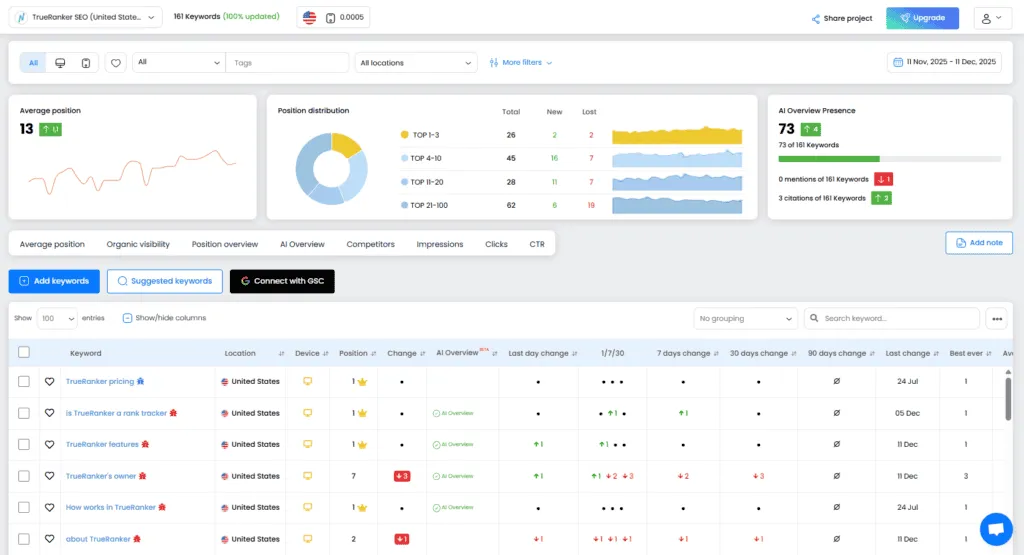
Don’t write “How to improve Local SEO.” Write: “How we climbed 15 positions for ‘SEO Agency London’ in 30 days (Real Case Study).” Use screenshots of your TrueRanker charts. That is irrefutable evidence. That is Information Gain.
2. Monitor AI Visibility (Exclusive Insights)
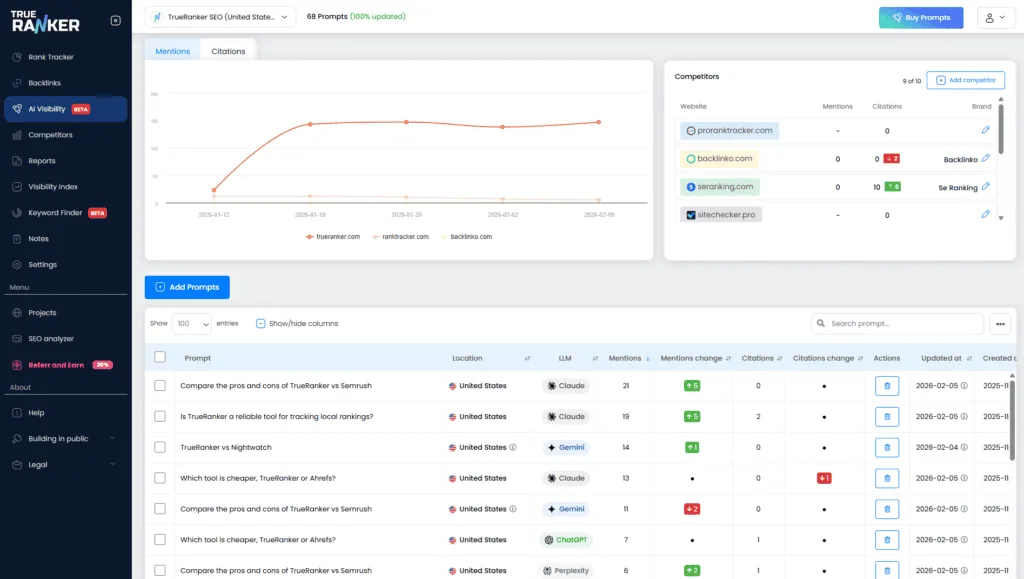
Most websites have no idea what ChatGPT says about them. Use our AI Visibility module and publish an analysis: “40% of AI models recommend [BRAND] over [COMPETITOR]: Visibility Analysis.” You are providing a data point that literally does not exist on the internet until you publish it.
3. Detect Local Trends
If you see in TrueRanker that a local keyword is spiking in volume in a specific city, be the first to report it.
Conclusion: AI is the Brush, Not the Painter
This Core Update is not the end of SEO; it’s the end of lazy SEO.
Artificial Intelligence remains an incredible tool for structuring, summarizing, and assisting. But the raw material (the idea, the data, the expertise) must be yours.
If you want to stop sweating every time Google announces an Update, start treating your content like a product: if you wouldn’t buy it, don’t publish it.
Have you noticed changes in your Discover traffic this week? Check your positions right now on TrueRanker to see if “AI Slop” has impacted you.
FAQ: Understanding the February 2026 Core Update
What is “AI Slop” content?
“AI Slop” refers to low-quality, mass-produced content generated by Artificial Intelligence that adds no new value, human expertise, or original data. These are articles that simply rephrase existing top search results, creating a feedback loop of redundant information that Google is now aggressively filtering out of its index.
Does Google penalize all AI-generated content?
No. Google penalizes lack of value, not the tool used. You can use AI to outline, proofread, or brainstorm, but the final output must demonstrate “Information Gain”—proprietary data, expert opinions, or unique angles that an AI model cannot hallucinate on its own.
How can I recover my traffic if I was hit by this Core Update?
The fix is editorial, not technical. You must audit your content and ask: “Does this article say anything new that isn’t already on Wikipedia?” If the answer is no, you have two choices: delete it (Deindex) or enrich it with real data, case studies, or proprietary charts (using tools like TrueRanker) to make it unique.
Did your rankings survive the Update?
Don't guess. Check your Google positions and AI visibility right now.
Written by

Javier Quevedo
Co-Founder & CEO, SEO Lead
Javier co-founded TrueRanker and leads the frontend, the public website, and the last mile between a ranking in the database and the screen an SEO actually uses. He has spent years turning GEO, local SEO, on-page work and AI visibility into product — and into the guides on this blog — so agencies can measure ChatGPT citations the same way they already measure Google. He also works the backend: a clean interface over stale data is still a lie.