What Is Content Engineering? My SEO and GEO Framework
Content engineering plans pages for search intent and AI citation. Learn chunk-friendly structure, direct answers, and E-E-A-T without the fluff.

Most teams still treat a blog post as a long essay with a keyword in the title. That worked when the only job was to rank a document in ten blue links. It falls short when ChatGPT, Perplexity, Gemini or Google AI Overviews pull a short fragment and stitch an answer.
Content engineering is how I plan that page so both jobs can succeed: rank for the intent, and stay quotable when a model chunks the HTML. I contrast it with content marketing, then walk through the framework I use for SEO and generative engine optimization.
What content engineering actually is
Content engineering is the data-led practice of planning, designing and structuring pages so they resolve one real search intent and stay easy to process for Google and for generative models.
The unit of work isn’t “write 2,000 words.” It is one URL for one intent, with headings that map sub-questions, sections that stand alone when quoted, and claims you can source. A content engineer decides what belongs on the page before a sentence is drafted — the same habit as a solid data-driven SEO brief, plus one extra requirement: extractability.
I use it when the brief is informational and the SERP already rewards depth: definitions, how-tos, comparisons. I don’t use it as a synonym for “ship more AI drafts.” Volume without structure is how you get pages that rank nowhere and get cited nowhere.
Content engineering vs content marketing
Content marketing owns the story and the calendar. Content engineering owns the architecture of each URL so search and AI can use that story.
| Content marketing | Content engineering | |
|---|---|---|
| Primary goal | Reach and persuade an audience | Resolve one search intent with extractable structure |
| Unit of work | Campaign, theme, content pillar | One URL, one H1, stepped H2/H3 chunks |
| Success signal | Engagement, pipeline, brand lift | Rankings, snippets, mentions, citations |
| Typical risk | Beautiful prose that never ranks | Thin templates that rank but say nothing new |
You still need marketing judgment. Engineering without a buyer and a thesis is scaffolding. Marketing without structure is a wall of text that models skip.
When someone asks for content engineering vs content marketing, I point at this table: same brand voice, different job on the page.
Why classic SEO still gates GEO
If your page is not a retrieval candidate in traditional search, generative engines rarely cite it as a source. Classic SEO is still the gate.
Retrieval systems and answer engines both need a document they can find, trust and quote. GEO (generative engine optimization) adds a second layer — chunking, synthesis, citation — but it doesn’t replace relevance and authority. I have watched teams polish “AI-ready” copy on URLs that never entered the top set for the topic. The model had nothing useful to retrieve.
That is why I still start with intent, SERP coverage and on-page clarity before I talk about prompts or AI Overviews.
Deterministic SERP pipeline vs probabilistic LLM answers
Traditional SEO scores whole documents for a ranked list. GEO retrieves candidates, then an LLM assembles an answer from fragments under uncertainty.
| Stage | Classic SEO (deterministic list) | GEO / LLMO (probabilistic answer) |
|---|---|---|
| Input | Query → documents | Query → documents → chunks |
| Decision | Relevance + authority → ordered SERP | Model reasoning over fragments → one synthetic answer |
| What winning looks like | Rank position and click | Citation, mention or recommendation in the answer |
| Failure mode | Page 2 and no traffic | Retrieved but never quoted |
Structured content for AI means writing as if both columns are true: the document must rank, and each section must survive alone as a chunk. That is semantic content architecture in practice — entities, clear subject–predicate–object lines, headings that name the question they answer.
The content engineering framework I use
My content engineering framework has five moves: curate sources, lock one intent, cut chunk-sized sections, open every heading with a direct answer, and inject experience the model cannot invent.
I run them in that order. Skipping research and jumping to formatting is how you get polite filler that sounds confident and wrong.
Research without hallucinations (RAG and source curation)
Before drafting, I ground the page in verified sources, product facts and competitor gaps — the same idea as retrieval-augmented generation, done by a human editor.
I open the top results for the primary query, list questions they leave half-answered, and refuse to invent a statistic I cannot cite. If the brief only has a keyword and a word count, I send it back. Unbounded generation is how “semantic fluff” lands in the draft: long introductions, empty adjectives, no scene a reader can check.
For proprietary claims I use product data or screenshots. For industry claims I link the source. That is how I keep E-E-A-T content honest when half the SERP is recycled AI prose.
One URL, one intent, stepped headings
Each page gets one primary intent in the title and H1. H2s carry derived questions; H3s break long tails or lists under those H2s.
I don’t park two buyer jobs on one URL to save publishing slots. “What is X” and “best X tool for agencies” are different intents. Mixing them makes the lede muddy and gives the model two competing extract targets. The heading ladder is the map: H1 → H2 → H3, no skipped levels, no empty labels like “Overview” or “FAQ” without a spoken question.
Chunking-friendly sections (110–320 words)
Each H2 or H3 block should ideally land between about 110 and 320 words (~150–400 tokens) so a model can lift it without dragging half the article.
That is what I mean by chunking-friendly content. Inside the block I avoid “as I said above,” “this,” and “the previous point” as the only glue — those phrases break when the chunk is quoted alone. If a section needs prior context, I restate the noun in one short clause and move on.
When a draft balloons past ~320 words under one heading, I split it. Length for its own sake doesn’t help AI search visibility; clean boundaries do.
First-sentence answers and semantic triplets
The first one or two sentences under every H2 and H3 answer the heading before I expand. Key lines follow a clear subject + predicate + object shape.
That opening pair is what featured snippets and generative summaries prefer. “Content engineering designs pages for one intent and for extractable sections” beats a warm-up about how the industry is changing. Triplets help entity linking: TrueRanker tracks citations across ChatGPT and Gemini is easier to ground than a fog of adjectives.
I still write for a human scanning on a phone. Short paragraphs (three to four lines), strategic bold on ideas worth skimming, no “in today’s fast-paced world.”
E-E-A-T that AI spam cannot fake
Experience shows up as scenes, numbers and product-true details — not as a louder claim that “we’re the experts.”
Empty intensifiers (“huge,” “incredible,” “fundamental”) and stock intros are the opposite of trust. I’d rather show a specific query, the heading that failed, and the rewrite that fixed the extract. Schema and JSON-LD help crawlers label author, organization and article entities; they don’t replace a paragraph only your team could have written.
Google’s own helpful content guidance still asks whether a person leaves knowing enough to do the job. That test is how I re-read every section before I publish.
Tables, lists and FAQs make chunks easy to lift
Tables, bullet lists and real FAQ questions give both readers and models a handle. Soft walls of prose don’t.
I keep these formats on almost every engineered page:
- Semantic HTML tables for comparisons (marketing vs engineering, SEO vs GEO, criteria vs criteria).
- Bullet lists for steps, components or failure modes — one idea per bullet.
- FAQ blocks with spoken questions as headings and self-contained answers.
- Internal links wrapped in co-occurring terms that match the destination, after I’ve answered the objection in the paragraph.
Conversion sits inside that clarity. If the reader still wonders what happens next, I resolve the doubt in the copy, then link to a tool or sibling guide. I don’t drop a trial pitch into a definition block that hasn’t earned it.
When page-one rankings still lose the AI Overview
The pattern I keep seeing: a URL ranks on page one for a how-to query, then AI Overviews quote a competitor who answered the H2 in the first sentence.
The weak section often opens with three paragraphs of history under a heading like “How to track keyword rankings daily.” Useful later; useless as a chunk. The fix is boring and effective — cut the history into a shorter aside, put the procedure in the first two lines, and cap the block near 220 words with a three-step list. Rankings often barely move. What changes is whether the Overview has a clean chunk to quote. The win is extractability, not a new backlink.
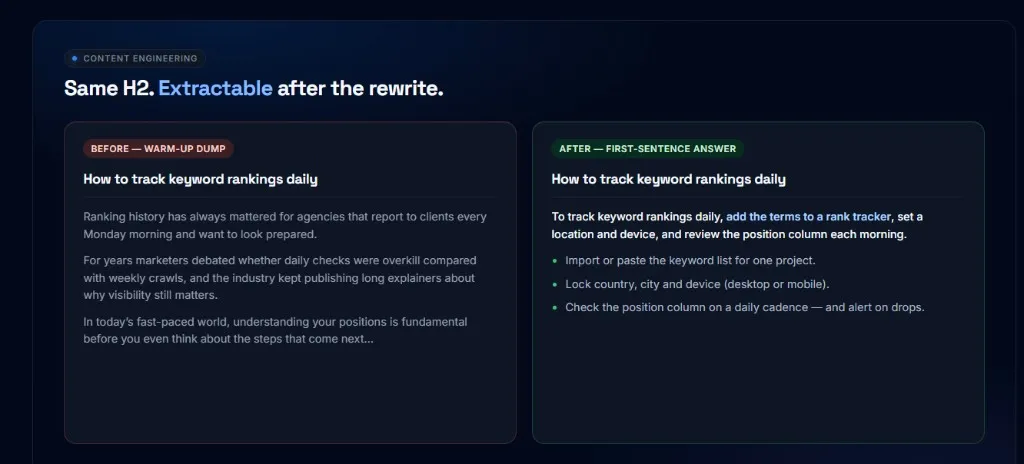
Same keyword, same URL, better chunks — that is the argument for content engineering in one scene.
How I measure whether the page gets cited
Rank tracking tells me if Google still surfaces the URL. Mentions and citations tell me if assistants reuse it.
After a structural rewrite I watch three signals: classic position for the primary query, whether the brand is named in answers, and whether the answer links the URL. Those last two aren’t the same metric — I break them out the way I describe in AI mentions vs citations.
If you want a quick pass on whether the page is even readable for GEO checks, start with the free AI visibility content checker. For ongoing AI search visibility across engines, you need history on the prompts you care about, not a one-off screenshot.
One mid-article CTA is enough here: fix the chunks first, then measure. Shipping another 1,500 words without a measurement loop is how the same soft section fails twice.
Frequently asked questions
What is a content engineer?
A content engineer designs how information is structured on the page so humans, search engines and generative models can use it — briefs, heading maps, chunk rules, source checks and measurement — not only the final prose.
Some teams split “structured content” roles from “AI pipeline” roles. In a smaller SEO team, one person often wears both hats: they own the template and they refuse drafts that fail the direct-answer test.
Is content engineering the same as GEO?
No. Content engineering is the broader discipline of structuring pages for intent and extractability. GEO is the layer focused on generative engines and AI answers.
You can practice content engineering for classic SEO alone. GEO without solid engineering usually means prompt superstition on pages that never get retrieved.
How long should each section be?
Aim for roughly 110–320 words under each H2 or H3 so the block stays chunking-friendly, then split if you overrun.
That is a guideline, not a hard CMS rule. A tight definition can be shorter. A worked example with a table can sit near the top of the range. If you need 600 words, you probably need two headings.
Do I still need keywords if I optimize for AI?
Yes. Keywords and intent still decide which documents enter the retrieval set. AI optimization doesn’t replace a clear primary query; it changes how you write once that query is locked.
I place the primary near the start of the title and H1 in spoken English, then cover secondaries only where they already fit the argument of a section — never as a density target.
Check whether assistants can extract your page
Run a free AI visibility content check, then track mentions and citations once the structure is in place.
Written by

Javier Quevedo
Co-Founder & CEO, SEO Lead
Javier co-founded TrueRanker and leads the frontend, the public website, and the last mile between a ranking in the database and the screen an SEO actually uses. He has spent years turning GEO, local SEO, on-page work and AI visibility into product — and into the guides on this blog — so agencies can measure ChatGPT citations the same way they already measure Google. He also works the backend: a clean interface over stale data is still a lie.
You might be interested
Data-Driven SEO Writing: How to Create Content that Ranks [2026]
Stop writing blindly. Learn how to create a data-driven content strategy, analyze search intent, and monitor your results with TrueRanker.
Javier Quevedo3 min read
Read the post