

For 20 years, the rule was simple: Optimize for Google, and customers will find you.
But in 2026, the rules of the game have changed completely.
Imagine your potential customer. They are no longer just typing “best running shoes” into Google. Now, they open ChatGPT, Gemini, or Perplexity and ask: “Recommend me running shoes for a sub-3-hour marathon and tell me why they are good.”
The AI doesn’t give them 10 blue links to choose from. It gives them a single answer.
If your brand isn’t in that answer, you don’t exist.
Welcome to the era of GEO (Generative Engine Optimization). In this article, we explain what it is, how it differs from traditional SEO, and most importantly, how to measure if you are winning the AI battle.
What is GEO (Generative Engine Optimization)?
GEO is the art and science of optimizing your content to be selected, cited, and recommended by Generative Engines (such as ChatGPT, Claude, Gemini, or Google’s AI Overviews).
While SEO fights for clicks, GEO fights for authority and citations.
SEO Goal: Appear on the first page so the user visits your website.
GEO Goal: Be part of the answer the AI generates for the user.
SEO vs. GEO: The 3 Key Differences
To understand how to adapt your strategy, look at this comparison:
| Feature | Traditional SEO | GEO (AI Optimization) |
| Success Metric | Traffic & Ranking Position | Mentions & Brand Sentiment |
| Winning Format | Lists & Keywords | Structured Data & Topical Authority |
| Competition | Top 10 Results | Winner-takes-all (Only 1 or 2 are mentioned) |
GEO is much crueler. On Google, being the 4th result still brings you traffic. In a ChatGPT response, if you aren’t the primary recommendation, you are invisible.
How to Optimize Your Brand for AI (GEO Strategy)
Based on data we’ve analyzed at TrueRanker by monitoring thousands of prompts, here is what LLMs reward:
1. Citations & Co-occurrence (More Important than Backlinks)
AI doesn’t care as much if you have a “dofollow” link. It cares that your brand is mentioned alongside words like “best,” “top,” or “recommended” on authoritative sites (Reddit, G2, Capterra, major news outlets).
2. Clarity & Structure
LLMs are statistical machines. They love content that is easy to process.
Use Schema Markup (JSON-LD) to tell the machine exactly what you are.
Write direct definitions (“TrueRanker is…”).
Use comparison tables for data.
3. Brand Entity Authority
If you ask ChatGPT “Name a cheap SEO tool,” it searches its knowledge base for entities associated with “SEO” and “Cheap.” If your website only talks about “sneakers,” it will never recommend you. You need to build strong topical authority.
The Big Problem: “You Can’t Improve What You Don’t Measure”
This is where 99% of agencies and businesses fail today.
They know their position on Google (Rank Tracking), but they are flying blind on AI.
Is ChatGPT recommending you when someone searches for your services?
What does Gemini say about your competitors?
Is Perplexity citing your latest article?
Until now, it was impossible to know without manually asking a thousand times.
The Solution: AI Visibility Tracking
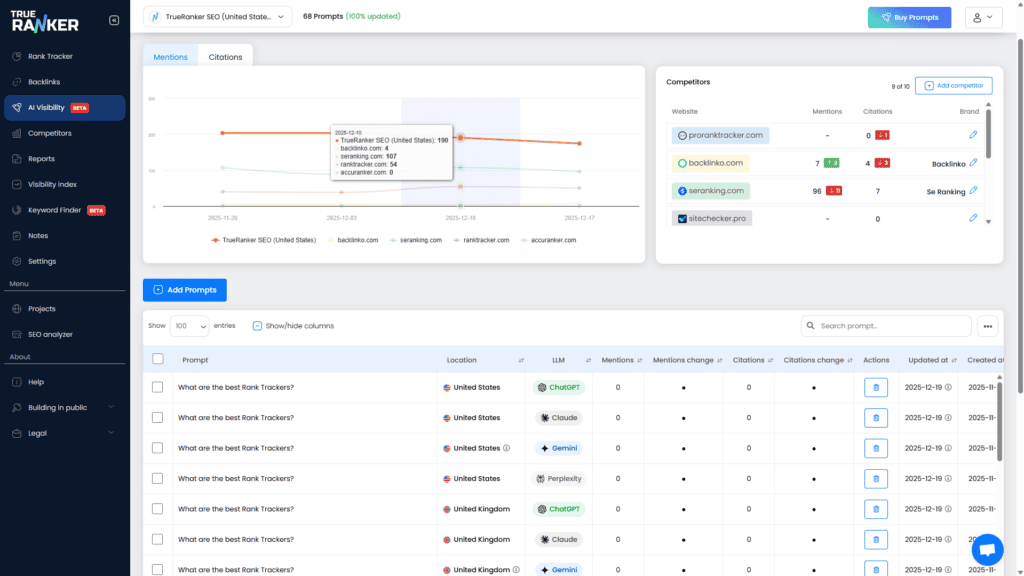
At TrueRanker, we have launched the first tool on the market to analyze your visibility on ChatGPT and Gemini.
You no longer have to guess. Our AI Visibility Tracker module allows you to:
Audit Your Presence: Discover what percentage of the time (Share of Voice) your brand appears when a user types a prompt related to your sector.
Spy on Competitors: See if the AI recommends your rivals before you and analyze why.
Control the Prompt: We don’t use generic questions. You define exactly what your ideal customer would ask.
Conclusion: SEO Is Not Dead, It Evolved
Don’t stop doing traditional SEO; Google still sends the majority of traffic. But ignoring GEO is like ignoring SEO in the year 2000.
Conversational searches are growing exponentially. Make sure that when the AI speaks, it speaks well of you.